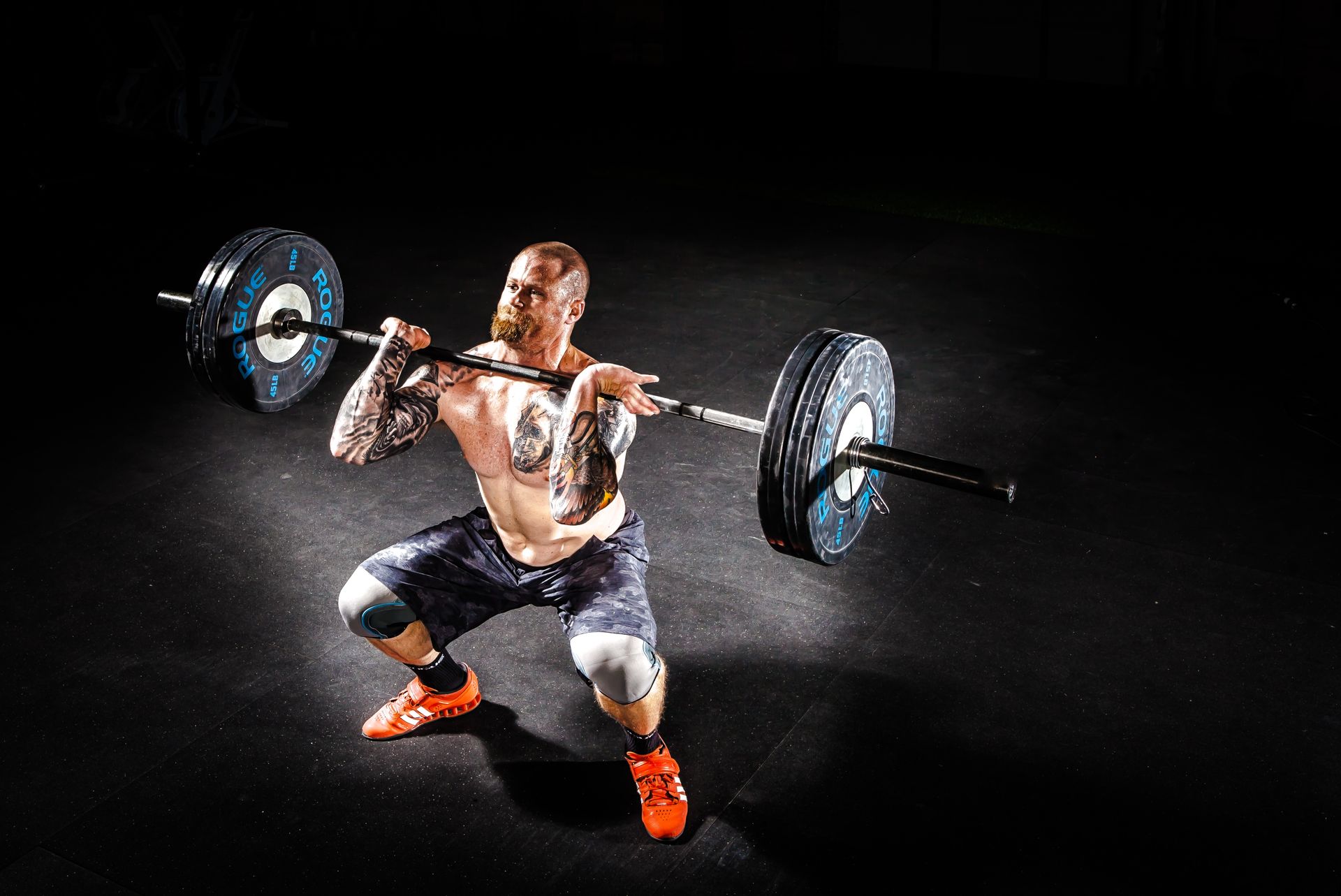
The back squat is a forgiving lift. Lean a little too far forward and the bar stays on your back anyway — it just becomes a good morning with extra steps. The front squat offers no such mercy. The bar sits in front of your throat on a shelf made of your own shoulders, and the moment your torso pitches forward or your elbows drop, it rolls off and the rep is over. That's not a flaw in the lift. That's the whole point.
Because the front squat is self-policing, it teaches the two things most back squats are missing: an upright torso and a trunk that braces like it means it. And it does this while hammering the quads harder than any squat variation you can load heavy — with, as we'll see, measurably less grinding on the knee joint than the back squat. For a powerlifter, it's the best secondary squat in existence. For a lifter with beat-up knees or stiff shoulders, it might be the main squat you should have switched to years ago.
The back squat is a strength test. The front squat is a strength audit.
Most lifters avoid it for the wrong reasons: the rack feels awful the first month, the weights look embarrassing next to their back squat, and nobody competes in it. This guide fixes the first, reframes the second, and makes the third irrelevant. Here's what it covers: why the front squat earns its place in a powerlifting program, the three rack positions and which one is actually yours, the rep broken down step by step, the five mistakes everyone makes (and the fix for each), an honest front-vs-back comparison, and a programming framework you can slot in next week.
What this guide covers: the case for the front squat (quad drive, torso integrity, joint-friendly loading), clean grip vs. cross-arm vs. straps, the full setup and rep sequence, the five universal mistakes with fixes, front squat vs. back squat head-to-head, and programming: loading, sets and reps, and a 4-week starter block. If you run CMS's SBD Full Powerlifting track, the engine already slots the front squat as your secondary squat when your sticking point says so.
Why the Front Squat Belongs in Your Program
Powerlifters skip the front squat because it doesn't count. Nobody's total includes it, so it feels like training for a sport you don't play. That's the wrong frame. The front squat isn't a fourth competition lift. It's a developer for the three you have — and it develops the exact qualities back-squat-only training neglects.
It builds the quads without apology. Move the bar from behind your neck to in front of your throat and the physics of the lift change completely. The anterior load forces a near-vertical torso, and a vertical torso at depth puts the knees far forward of the toes and the load squarely on the quadriceps. There is no hip-dominant escape hatch. If your back squat dies halfway up because your quads check out, the front squat is the direct deposit.
It audits your torso. You cannot front squat with a soft trunk. The bar's position means any loss of upper-back tightness or bracing shows up instantly as a rolling bar. Months of front squatting build the thoracic extension and anterior-core bracing that carry straight back to a heavier, more upright back squat — and to a deadlift whose upper back stops rounding off the floor.
It's the joint-friendly heavy squat. This one has data behind it. Gullett and colleagues compared front and back squats in trained lifters and found the front squat produced significantly lower compressive forces and extensor moments at the knee — while recruiting the lower-body musculature just as effectively as the back squat (Gullett et al., 2009). Same engine, less grinding on the joint. For masters lifters and anyone managing cranky knees, that's not a footnote. That's the argument.
It governs itself. You can grind an ugly back squat rep and call it a PR. You cannot grind an ugly front squat rep — the bar leaves, and the set tells the truth. This self-limiting quality makes it one of the safest heavy lifts in the gym and one of the best teachers: every rep is either technically sound or it doesn't happen.
Three Ways to Rack It
The rack position is where front squats go to die, and it's almost always a solved problem wearing a scary mask. There are three legitimate ways to hold the bar, and one of them fits you. The goal of all three is identical: the bar rests on the shelf of your front deltoids, close to your throat, with your upper arms parallel to the floor.
The honest recommendation: learn the clean grip if your joints allow it, because it's the most stable and transfers best. But treat straps as a legitimate permanent option, not a crutch — the training effect on your quads and torso is identical either way, and the bar doesn't care what your hands are doing. If your shoulders won't tolerate a low-bar back squat either, the front squat with straps is the other side of that coin: no rear shelf, no reach-back, no shoulder external rotation at all. The full shoulder-friendly squatting playbook is in Low-Bar Squat With Stiff Shoulders.
The Rep, Step by Step
Set the rack height so the bar sits at mid-chest — you should unrack with a slight dip of the knees, not a calf raise, and not a good-morning-out-from-under. Then:
- Build the shelf. Step under the bar, let it settle across your front delts, and shrug your shoulders slightly up and forward into it. The bar should sit close to your throat — uncomfortably close. If it feels like it's choking you, it's a touch too high; slide it down half an inch onto the delt meat.
- Set your grip and elbows. Clean grip: fingertips under the bar, just outside the shoulders. Straps: grab the tails. Cross-arm: fold and pin. Then drive the elbows up until your upper arms are parallel to the floor. Not "high-ish." Parallel. This is the position the entire rep depends on.
- Unrack and walk it out. Two to three steps, same discipline as a back squat. Set your feet at your squat stance — many lifters go slightly narrower than their back squat, but don't force it.
- Brace like the bar is heavier than it is. Big breath into the belly, ribs pulled down, trunk locked. The anterior load wants to fold you; your brace is the only thing voting no.
- Break knees and hips together. This is not a sit-back lift. Let the knees travel forward over the toes from the first inch — fighting it is the single most common setup error. Torso stays tall because the elbows stay up.
- Take it below parallel. Hips below the knees, hamstrings on calves if your mobility allows. The front squat rewards depth; a shallow front squat is a contradiction — you chose the quad lift, so use the quads' full range.
- Drive the elbows to the ceiling. Out of the hole, the cue is not "stand up" — it's "elbows up." Lead with the elbows and the hips follow. The moment you think "push the floor away" and forget the elbows, the bar starts its roll.
Film your first sessions from the side. What a front squat feels like and what it looks like are two different lifts for the first month, and the video is the only honest coach in the room until the positions become automatic.
The Five Mistakes Everyone Makes
Every front squat failure you've ever seen — in your own training or anyone else's — is one of these five. The fixes are in order of how often they occur:
- The elbows drop mid-rep. The bar rolls forward, the throat closes, the rep dies. This is the front squat mistake the way missing depth is the back squat mistake. Fix: "elbows up" is the only cue that matters, and if they won't stay up, the weight is too heavy or the rack position is wrong. Drop the load until every rep finishes with elbows where they started.
- The heels lift and everything pitches forward. Usually ankle mobility, sometimes a stance that's too narrow for long femurs. Fix: weightlifting shoes with an elevated heel are the cheapest technique fix in the gym — they're practically made for this lift. Widen the stance a touch and, again, let the knees travel.
- The knees cave. Same fix as the back squat, same urgency: screw the feet into the floor, drive the knees out over the toes, and take weight off until you own the position. Knee valgus under an anterior load is not a style choice.
- Dumping out of the hole. You hit depth fine and then pitch forward on the way up — upper back rounding as fatigue sets in. Fix: pause front squats. A 2-count pause at the bottom teaches you to own the position under load, and it exposes the exact moment your elbows start to fall. Two counts, no bounce, elbows up the whole time.
- The bar chokes you. Some throat pressure is normal — the bar sits close by design. Actual choking means the bar is riding too high, on the windpipe instead of the delt shelf. Fix: reset the bar half an inch lower onto the meat of the shoulders and shrug up into it. Discomfort is part of the lift; asphyxiation is a setup error.
Notice what isn't on the list: wrist pain as a reason to quit. Sore wrists in week one are the mobility tax; wrists that still hurt in week six mean the bar is in your hands instead of on your delts, or you need the straps. Solve it, don't surrender to it.
Front Squat vs. Back Squat, Honestly
These are not rivals. They're a pair — the competition lift and its developer. But lifters deserve the straight comparison:
The takeaway for programming: the back squat is the lift you compete in and the front squat is the lift that keeps it honest. Run them together and each one covers the other's blind spot — the front squat builds the quads and upright torso the back squat lets you neglect, and the back squat builds the absolute load the front squat can't match.
How to Program It
For a powerlifter, the front squat is a secondary squat — one session a week, behind the competition back squat, never before it. Its job is to build the quads and torso that make the back squat go up, not to become a second max-effort day. Treat it like the accessory it is and it pays compound interest; treat it like a competition and it just steals recovery.
Loading. Most trained lifters front squat 75 to 85 percent of their back squat. If you squat 400, expect a 300–340 front squat once the technique is grooved — less in the first month while the rack position is the limiter. If your front squat sits under 70 percent of your back squat after the learning curve, that's diagnostic: your upper back or rack position is the weak link, and the front squat is already doing its job by exposing it.
Sets, reps, and effort. The front squat lives in the 3–6 rep range — heavy enough to matter, short enough that the rack position doesn't disintegrate. Keep the RPE ceiling at about 8.5: the lift's self-limiting nature means grinding is self-defeating, and a dumped rep teaches nothing. If RPE as a language is new, learn it here first — the front squat is the lift where "one more rep" most often means "one dumped bar."
- Standard secondary work: 3–5 sets of 3–6 reps at RPE 7–8.5. This is the bread and butter — slot it after your main squat or on deadlift day.
- Pause front squats: 3–4 sets of 3 with a 2-count pause at the bottom, RPE 7–8. The technique builder. Run these whenever the elbows start dropping.
- Tempo front squats: 3 sets of 4 with a 3-second descent. For lifters who dive-bomb the descent and lose position — the tempo removes the bounce and forces ownership.
- Frequency: once a week as the secondary squat. Twice a week only in a dedicated quad-emphasis block, and never the day before heavy back squats.
A 4-week starter block. Run this as your secondary squat day, after a 2–3 week technique phase with just the bar and light loads to groove the rack:
- Week 1: 4 × 5 at RPE 7 — learn the positions under moderate load.
- Week 2: 5 × 4 at RPE 8 — add a set, add intent.
- Week 3: 4 × 3 at RPE 8.5, or 3 × 3 paused — the heaviest week, still no grinders.
- Week 4: 3 × 5 at RPE 7 — back off, keep the pattern crisp, then start the next block heavier.
Where it sits in the week matters. The full logic of secondary-lift placement — which slot, which block, which phase — is the periodization guide's territory. The short version: front squat goes in the accumulation and strength blocks as the second squat, gets lighter or disappears in the peak, and is gone in the taper. It builds the base; it doesn't sharpen the peak.
And on the bad days — the sleep was short, the warmup feels like a max — the front squat is the lift to autoregulate, not the lift to prove something on. Drop to straps, drop the weight, keep the positions. The bar that keeps you honest is only useful if you listen to it.
Front Squats After 40
This is where the front squat quietly becomes more than an accessory. The Gullett finding — equal muscle recruitment with significantly less compressive force at the knee — matters more with every year of training mileage on your joints. For masters lifters managing cranky knees, the front squat is the rare lift that lets you train the squat pattern hard without paying the back-squat joint tax every session.
Two practical adjustments. First, the rack: if the clean grip beats up arthritic wrists, go straight to straps and don't look back. The training effect is identical and the wrists stay out of the equation. Second, the RPE ceiling: masters lifters recover on a slower clock, so cap front squat work at RPE 8 and let the volume do the talking. The lift's self-limiting nature is a feature here — it's very hard to overreach on a lift that dumps you the moment your positions go.
If your shoulders are the reason you're reading squat alternatives in the first place, you're in the right place twice over: the front squat asks nothing of shoulder external rotation, which is exactly why it sits in the stiff-shoulders playbook alongside the safety squat bar. Route around the joint, keep the pattern.
Front Squat: Common Questions
How much should I front squat compared to my back squat?
Most trained lifters front squat roughly 75 to 85 percent of their back squat. If you back squat 400, a 300 to 340 front squat is right in line. If yours is under 70 percent, the limiter is usually the rack position or upper-back strength, not your legs — which is exactly what the front squat is there to fix.
Why does the front squat hurt my wrists?
In the clean grip, the bar sits on your delts and your fingertips just keep it from rolling — your wrists shouldn't be carrying load. Pain usually means the bar drifted into your hands (elbows dropped) or your wrist and lat mobility is the limiter. Loop lifting straps over the bar and hold the tails: you get the clean-grip rack without the wrist extension, and plenty of strong lifters rack this way permanently.
Can the front squat replace the back squat?
For a competitive powerlifter, no — the back squat is the competition lift and specificity wins. For a general lifter who just wants strong legs, it absolutely can: it recruits the lower-body musculature as effectively as the back squat with significantly less compressive force at the knee (Gullett et al., 2009). Most powerlifters run it as the secondary squat, one day a week behind the back squat.
Is it normal for my knees to travel past my toes?
Yes — it's required. The anterior bar position forces an upright torso, and an upright torso at depth means the knees travel forward. Fighting it pitches you forward and dumps the bar. Let the knees go where they need to go, keep them tracking over your toes, and wear weightlifting shoes if your ankles are the limiter.
Why do I keep dumping the bar forward out of the hole?
Your elbows dropped or your upper back rounded as you fatigued, and the bar rolled off the shelf. The fix is pause front squats: a 2-count pause at the bottom teaches you to own the position under load, and it exposes exactly the moment your elbows start to fall. Drop the weight until every rep finishes with your elbows where they started.
Do I need weightlifting shoes to front squat?
Not required, but they help more here than on any other lift. The elevated heel lets the knees travel forward with less ankle demand, which is the entire mechanical premise of the front squat. If your ankles are stiff and you want to front squat deep, heeled shoes are the cheapest technique fix in the gym.
References
- Gullett JC, Tillman MD, Gutierrez GM, Chow JW. A biomechanical comparison of back and front squats in healthy trained individuals. J Strength Cond Res. 2009;23(1):284-292. PubMed 19002072
- Schoenfeld BJ. Squatting kinematics and kinetics and their application to exercise performance. J Strength Cond Res. 2010;24(12):3497-3506. PubMed 20182386