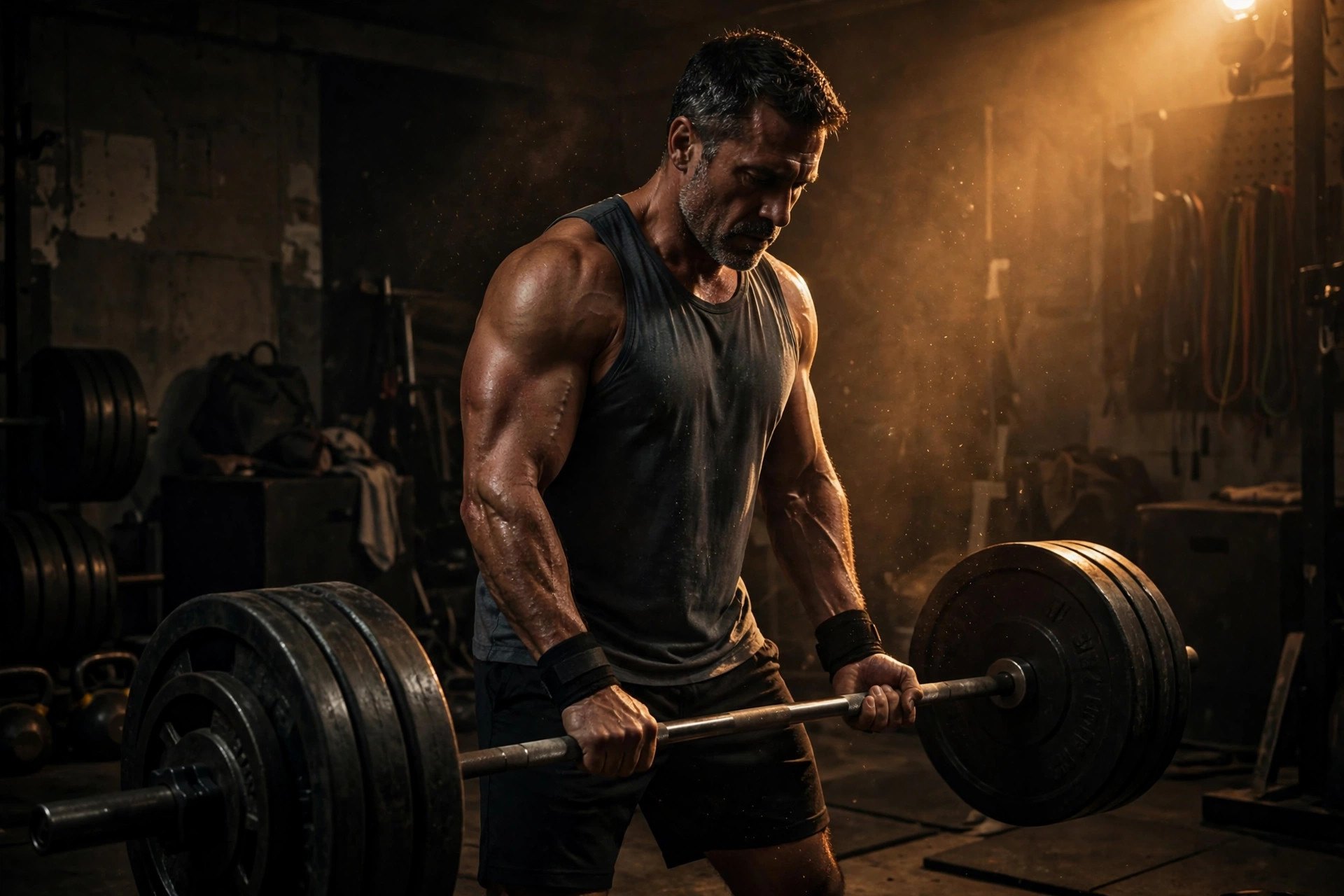
Walk into any gym and you'll see two tribes training with the same equipment for completely different reasons. The bodybuilder is chasing a look — judges score the shape, size, and symmetry of the muscle. The powerlifter is chasing a number — a judge watches three attempts at squat, bench, and deadlift and the biggest total wins. Same barbell, two different scoreboards. And if you're a lifter trying to decide which game to play, the internet will hand you a decade of tribal arguments. Here's the plain version.
The real difference is what gets measured
Strip away the culture and the t-shirts and the difference between bodybuilding vs powerlifting is one sentence: bodybuilding is judged subjectively on appearance; powerlifting is judged objectively on performance. Everything else — the training, the eating, the schedule — flows from that single difference.
A bodybuilder's program exists to make muscle look bigger, fuller, and more complete from every angle. A powerlifter's program exists to make one-rep maximums go up on three lifts. Both build muscle. Both build strength. But each optimizes for its scoreboard, and the optimization changes nearly every training decision you make.
This is why the debate never ends: people compare the side effects instead of the scoreboards. "Powerlifters are fat." Some are — the unlimited weight classes reward mass, and a few lifters confuse bulk with strength. "Bodybuilders are weak." They're not — an 8-rep set of incline dumbbells with the 120s is serious strength, just not expressed as a one-rep max. The scoreboard you train for is the scoreboard you get good at. Judge each one by its own numbers and the tribal argument collapses.
How the training actually differs
Rep ranges. Powerlifting lives in the low reps — sets of 1 to 5 on the competition lifts, because that's the skill being tested. The classic "strength" range works because it trains the nervous system to fire every fiber at once. Bodybuilding lives in the moderate reps — sets of 8 to 15, sometimes 20 — because more time under tension across more exercises is what drives hypertrophy. Neither is magic; both are physics. Low reps practice maximum force. Higher reps accumulate the volume that grows tissue.
Volume and exercise selection. This is the biggest day-to-day difference. A powerlifter's week revolves around the squat, bench, and deadlift, plus close variations — pause squats, board presses, deficit deadlifts — that fix weak points in those lifts. A bodybuilder's week spreads volume across the whole body: chest day, back day, leg day, shoulders and arms, with isolation work for every head of every muscle. The bodybuilder does more total exercises and more total sets; the powerlifter does more total intensity on fewer movements.
Intensity and rest. Powerlifting training uses long rests — three to five minutes between heavy sets — because a set of three at 90% is a maximal effort and you can't repeat it on ninety seconds' rest. Bodybuilding uses shorter rests — one to three minutes — because the goal is to keep the muscle under load and chase the pump, not to be fully recovered for the next near-maximum attempt. Walk the floor and you can spot the training style by the rest timer alone.
Progression. Powerlifters track one-rep maxes and train in blocks — volume phases, strength phases, and a peaking phase before a meet — because the goal is a number on a specific day. Bodybuilders track reps, sets, and the mirror — progressive overload still applies, but the timeline is measured in months of added thickness, not weeks of added pounds. The powerlifter asks "what did I total?" The bodybuilder asks "how do I look?" Both are valid measurements of the same underlying work.
The diet difference is bigger than the training difference
If you took a powerlifter's training and fed it a bodybuilder's diet, you'd get a bodybuilder. The eating is where the two disciplines diverge hardest.
Bodybuilders live in a perpetual cycle: a growth phase in a controlled surplus, then a cut in a deficit to reveal the muscle underneath. Protein sits at the top of the range — roughly 1.6 to 2.2 grams per kilo of bodyweight — and food is weighed, timed, and planned around training. The cut is the brutal part: months of dieting while training hard enough to keep the muscle. It works, but it demands the kind of dietary discipline most people can't sustain, and it should be done carefully — prolonged deficits cost strength, energy, and sometimes health.
Powerlifters mostly eat to fuel and recover. Many run a gentle surplus in the off-season to push bodyweight up into a heavier, more competitive class, then hold or trim before a meet. Protein is still high, but the structure is looser — nobody is weighing broccoli at 9 PM because a judge is going to score their triceps in twelve weeks. The trade: mass gained without a plan includes fat, and fat gained without a plan rarely turns back into muscle without a hard cut.
The honest nutritional truth sits in the middle: a moderate surplus with high protein, sustained for a long time, builds both muscle and strength. The two sports just label it differently — one calls it a bulk, the other calls it the off-season.
Bodybuilding vs powerlifting: what do you actually get?
Strength. Powerlifting wins this one on its home turf, obviously — a trained powerlifter's one-rep maxes are in another league. But bodybuilding is not a weak endeavor. Years of high-volume training build a deep base of muscle that expresses as impressive strength in the 5–12 rep range. The bodybuilder who can strict-press 100-pound dumbbells for ten reps is not weak; they're just not practiced at singles. Strength is specific. You get the strength you train for.
Muscle and physique. Bodybuilding wins this one cleanly. Nothing in powerlifting matches the targeted volume bodybuilders pour into lagging muscle groups — the side delts, the upper chest, the calves nobody at a powerlifting meet ever thinks about. If the goal is to look like you lift with your shirt on, the bodybuilding approach builds more complete muscle, period. Powerlifting builds plenty of muscle too — you don't squat 500 without enormous quads — but it's distributed by what the lifts demand, not by aesthetics.
Longevity and joints. Both disciplines can be run safely for decades; both can break you if you run them badly. Powerlifting's risk concentrates in maximal attempts — the singles and doubles near 100% that define the sport's scoreboard. Bodybuilding's risk spreads across years of high volume on the same joints — the shoulders that press four times a week for a decade. After 40, both risks get louder. The smart move isn't picking the "safe" sport; it's picking the version of either sport that manages fatigue, programs deloads, and stops before the warning signs turn into injuries.
The war is fake — they're cousins
Here's what the tribal debate misses: at the level that matters for a recreational lifter, the two disciplines are doing almost the same thing. Both run on progressive overload. Both require years of consistency. Both build muscle, strengthen bones, and keep a body useful — which is the whole point after 40.
The muscle you build doing sets of ten becomes the engine for heavier singles later. The strength you build doing heavy triples becomes the base for more productive sets of ten later. Elite powerlifters do bodybuilding blocks in their off-seasons. Elite bodybuilders do heavy strength blocks when they plateau. The sports already borrow from each other; only the internet hasn't noticed.
This is the real answer to "should I powerlift or bodybuild?" — do the one whose scoreboard you actually care about, and steal the other's methods. If you want a bigger total, train the lifts and borrow the bodybuilder's volume for your weak muscles. If you want to look the part, train the muscles and borrow the powerlifter's heavy compound work for your base. The hybrid has a name — powerbuilding — and it's the most honest answer for most lifters.
The after-40 call
If you're over 40 and reading this, the calculus shifts. Sarcopenia — age-related muscle loss — is the enemy now, not your squat total or your stage conditioning. You need both: the heavy compound work that preserves bone density and the ability to stand up under load, and the volume work that keeps muscle mass on your frame.
That makes the powerlifting side of the ledger slightly more valuable after 40 — not because the sport is better, but because the habits it builds (heavy loading, programmed progression, tracking numbers) are exactly what an aging body needs to stay capable. The bodybuilder's contribution is the other half: enough volume across the whole body that nothing wastes away unnoticed.
So the practical prescription for a lifter over 40: train the big lifts heavy in the low-rep range, then chase them with bodybuilding-style volume on the muscles that keep you healthy — the upper back, the glutes, the shoulders, the arms. Heavy enough to stay strong. Enough volume to stay built. Recover like it's your job, because now it is.
Five mistakes lifters make choosing a lane
1. Training for a sport you don't compete in. If you don't plan to step on a platform or a stage, you don't need a meet peaking cycle or a twelve-week cut. Train the style, borrow the methods, skip the ceremony.
2. Copying the diet of the extreme. The 6,000-calorie powerlifter bulk and the 1,800-calorie contest cut are for competitors. A recreational lifter eating at either extreme is building a problem, not a physique.
3. Choosing by identity instead of by goal. "I'm a powerlifter" is a costume if your actual goal is to look good at the beach. Be honest about the scoreboard you care about, then train for it without apology.
4. Ignoring the other half. The pure powerlifter who never does direct arm or upper-back work ends up with a physique that doesn't match the total. The pure bodybuilder who never goes below eight reps leaves heavy strength on the table. Both misses are avoidable.
5. Maxing out like it's the sport. Singles test strength; they don't build it — in either discipline. The strength gets built in the submaximal sets, the volume, the boring weeks. The test is a single day. Train like the other 360.
The bottom line
Bodybuilding vs powerlifting isn't a war; it's a menu. One scores the look, one scores the lift, and both build the same foundation: years of progressive overload on a barbell. Pick the scoreboard that motivates you, borrow the other discipline's methods without shame, and after 40, make sure both sides of the ledger show up in your program — heavy enough to stay strong, enough volume to stay built. The lifters who last decades are the ones who stopped arguing about tribes and started training for the body they want to keep.