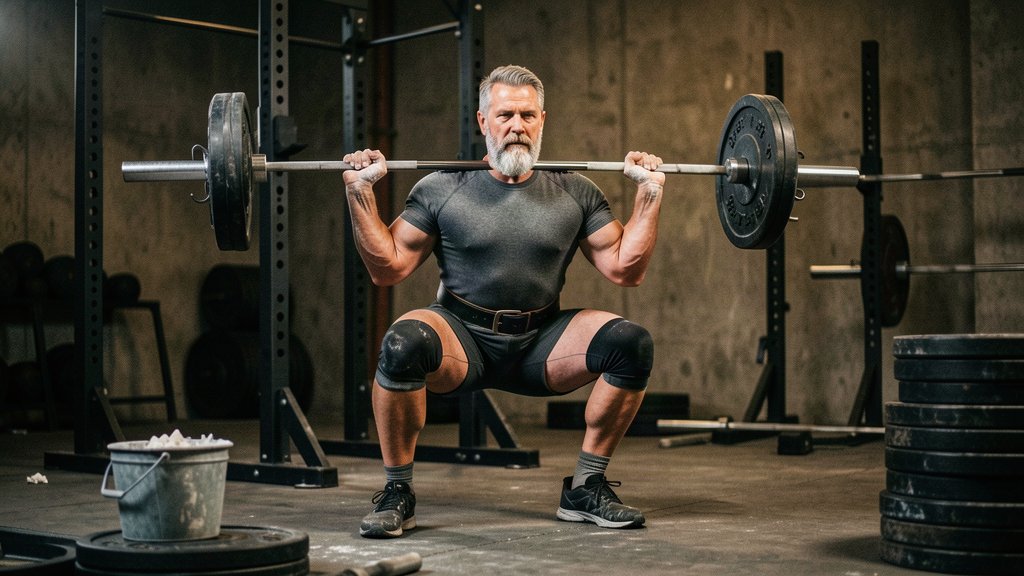
You're not really asking about safety. You're asking whether this sport will cost you your body — your back, your knees, your shoulders — before it gives anything back. Fair question. Here's the straight answer: the barbell isn't the risk. The gap between what you can lift and what you're prepared to lift is the risk. And that gap is programmable.
Powerlifting after 40 is safe the way driving is safe: it depends on the driver. The evidence is clearer than most lifters realize — trained adults keep getting stronger for decades, masters athletes keep making gains, and the injury rates in this sport are lower than almost anyone guesses. But the evidence comes with conditions. The conditions are the point of this article.
What the Research Actually Says About Masters Lifters and Injury
Start with the number that surprises everyone. Competitive powerlifters report roughly 1.0 to 4.4 injuries per 1,000 hours of training — comparable to other non-contact strength sports, and low next to contact sports (Aasa, 2017). When injuries happen, they cluster in the spine, shoulder, and knee. That's the low-risk picture, and it's well established.
Now the honest version. A cross-sectional study of 104 subelite powerlifters found that 87% had experienced an injury in the past year — where "injury" meant pain or impairment that affected their training. But read the second number: of the lifters currently injured, only 16% had to stop training completely (Strömbäck et al., 2018). Pain that changes training is common. "Can't train" is rare. And when the researchers looked for what predicted injury, the variables that showed up were training and lifestyle factors — a higher deadlift personal best, injuries that began during bench and deadlift work, alcohol use, dietary issues. Things you can actually change.
The performance data tells the same story from the other side. In 15 years of competition records, the biggest strength gains of a powerlifting career come in the first year — roughly 7.5–12.5% — and lifters keep improving for a decade after that (Latella et al., 2024). Female masters athletes over 59 were still gaining strength, at 2.5–5%. A study of powerlifters with competition records spanning decades concluded that age is a poor predictor of maximal strength (Wilf & Dunsky, 2025). Trained lifters don't ride the general population's aging curve. They flatten it.
Myth vs. Reality
| Myth | Reality |
|---|---|
| "Heavy lifting after 40 wrecks your joints." | Powerlifting injury rates run 1.0–4.4 per 1,000 training hours — low for a sport, comparable to other non-contact strength sports. Joints and tendons adapt to load, given time. |
| "You can't build strength after 40." | Masters lifters keep gaining for years. In the largest longitudinal dataset, women over 59 were still improving. Age is a poor predictor of strength in people who keep training. |
| "Sore means damaged." | Soreness is normal adaptation. Pain that keeps affecting your training, for weeks, at the same spot, is information. Different signals, different responses. |
| "After 40 you should train light forever." | The evidence favors heavier, well-managed training. High-intensity resistance training is where the bone, muscle, and metabolic benefits concentrate. Smarter beats lighter. |
The Documented Benefits: Why the Risk Is Worth Managing
Bone density. A review of nearly two dozen studies found a direct, positive relationship between resistance training and bone density — and high-intensity resistance training added the bonus of improving strength, balance, and muscle mass at the same time (Layne & Nelson, 1999). The squatter and deadlifter are loading the spine and hips with exactly the stimulus those bones are built for.
Muscle mass. Across 49 studies of aging adults, resistance exercise produced a pooled gain of about 1.1 kg of lean body mass over roughly 20 weeks, with higher-volume programs driving more (Peterson et al., 2011). That is the direct antidote to the muscle loss sedentary adults quietly accumulate.
Metabolic health. In a randomized trial in adults with type 2 diabetes, resistance training alone cut HbA1c by about 0.4 percentage points — and combining resistance with aerobic training improved it further (Sigal et al., 2007). Lifting weights is metabolic medicine.
Longevity. Across cohort studies, any muscle-strengthening activity was associated with a 10–17% lower risk of all-cause mortality, cardiovascular disease, total cancer, and diabetes, with the biggest reductions around 30–60 minutes per week (Momma et al., 2022). The dose is small. The direction is consistent.
The Precautions That Actually Matter
Now the honest cost side. Three things change the risk math after 40, and none of them are "don't lift."
Connective tissue lags. Muscle gets strong faster than tendon gets durable. Tendons do adapt to heavy loading — the meta-analysis is clear — but the adaptation tracks loading magnitude and takes time, with larger effects in interventions lasting 12 weeks or more (Bohm et al., 2015). Months, not sessions. That lag is where the classic "my lifts feel fine but my joints hurt" injury comes from: the muscle was ready and the connective tissue wasn't. This is exactly the gap joint-load tracking exists to watch.
Your training max defines heavy, not your one-rep max. A working number that updates slowly protects you from the ego's worst day. A five percent band is enough to keep bad days productive and good days banked.
Persistent joint pain is a stop sign. Muscle soreness is a normal Tuesday. Joint pain that sharpens, or parks in the same spot for weeks, is data — and it's usually not "push through it." The joint-aware playbook, including when to rotate an exercise before the joint forces the issue, is in our guide to joint load management.
When to get cleared by a doctor. Modern pre-participation screening is not "get a note for everything." The ACSM's model screens on three things: your current activity level, any signs or symptoms, and known cardiovascular, metabolic, or renal disease — and it exists partly to stop unnecessary referrals that keep healthy people out of the gym (Riebe et al., 2015). If you have an unexplained symptom or a condition your doctor manages, get cleared first. If you're a healthy 40-year-old, start training and progress sensibly. This article is general training information, not medical advice.
How Intelligent Programming Changes the Risk Math
Here's the part that actually answers the question. Safety after 40 isn't a decision you make once — it's a system you run every week. The research and the training floor agree: the load management is the injury prevention.
- A submaximal base first. Months of moderate-load work before the heavy singles. This is the connective tissue catching up. Here's why submaximal training is the foundation, not the consolation prize.
- Block periodization with a scheduled deload. The deload arrives on the calendar before the body demands it — that's the whole trick. Rest is programmed, not negotiated.
- Readiness-based load adjustment. The day's state sets the day's load. RPE and bar speed are the tools, and RPE isn't a feeling — it's reps in reserve. Readiness changes everything after 40, and the logic holds a decade earlier.
- Volume before intensity. Add sets before adding kilos. Every time.
The rule you can act on tonight: if your warm-up sets move slower than they should, treat that as the signal it is — cut the working weight by five percent and call the session a win. Log it like a coach's note. Because that's what it is.
This is what the Adaptive System mechanizes: the readiness engine, the ±5% band, the deloads scheduled before the body demands them, the training max that updates slowly. The smart approach, running itself.
If you are starting from zero, the complete plan for how to powerlift after 40 lays out the first twelve weeks and the road to a first meet. Once safety is settled, the next question is dose: how often you should actually lift heavy after 40.
Is Powerlifting After 40 Safe? — Common Questions
Is powerlifting after 40 safe?
Yes, for most people, when the training is built around the lifter. Injury rates in the sport are low (1.0–4.4 per 1,000 training hours), masters lifters keep gaining strength for years, and the risk factors the research identifies are load, technique, and lifestyle variables — not age itself.
What are the most common powerlifting injuries after 40?
The systematic reviews consistently name the spine, shoulder, and knee; the pain-prevalence studies add the hip. Most are overuse and tendon issues that change training rather than stop it — which is precisely why load management is the safety program.
Can I still build muscle and strength after 40?
The data says yes. First-year strength gains in competitive powerlifters run 7.5–12.5%, masters women past 59 were still improving, and meta-analyses in older adults show large strength effects and meaningful lean-mass gains from resistance training.
When should I see a doctor before starting powerlifting after 40?
Get screened if you have a known cardiovascular, metabolic, or renal condition, any unexplained symptoms (chest pain, shortness of breath, fainting), or recent surgery. Otherwise the current ACSM screening model is designed so healthy adults can start — and should start — without a needless referral.
How heavy should I train after 40?
Heavy enough to challenge, rarely heavy enough to grind. Most volume lives at submaximal loads; heavy work is concentrated, intentional, and measured against a training max that updates slowly — never a one-rep max from a lucky day.
The Bottom Line
Is powerlifting after 40 safe? Yes — when the program does the risk management for you. The sport is hard on nothing except ignorance: ignorant loading, ignored pain, ignored recovery. Fix those three, and the evidence says you don't just survive heavy training in your 40s. You get measurably stronger, denser, and more durable than the people who quit.
References
1. Aasa U, Svartholm I, Andersson F, Berglund L. Injuries among weightlifters and powerlifters: a systematic review. Br J Sports Med. 2017;51(4):211–219. https://pubmed.ncbi.nlm.nih.gov/27707741/
2. Strömbäck E, Aasa U, Gilenstam K, Berglund L. Prevalence and consequences of injuries in powerlifting: a cross-sectional study. Orthop J Sports Med. 2018;6(5):2325967118771016. https://pubmed.ncbi.nlm.nih.gov/29785405/
3. Latella C, Teo WP, Spathis J, van den Hoek D. Using powerlifting athletes to determine strength adaptations across ages in males and females: a longitudinal growth modelling approach. Sports Med. 2024;54(3):753–774. https://pubmed.ncbi.nlm.nih.gov/38060089/
4. Wilf O, Dunsky A. Age is a poor predictor of maximal strength in competitive powerlifters. Kinesiology. 2025;57(2):212–219. https://doi.org/10.26582/k.57.2.7
5. Borde R, Hortobágyi T, Granacher U. Dose–response relationships of resistance training in healthy old adults: a systematic review and meta-analysis. Sports Med. 2015;45(12):1693–1720. https://pubmed.ncbi.nlm.nih.gov/26420238/
6. Peterson MD, Sen A, Gordon PM. Influence of resistance exercise on lean body mass in aging adults: a meta-analysis. Med Sci Sports Exerc. 2011;43(2):249–258. https://pubmed.ncbi.nlm.nih.gov/20543750/
7. Layne JE, Nelson ME. The effects of progressive resistance training on bone density: a review. Med Sci Sports Exerc. 1999;31(1):25–30. https://pubmed.ncbi.nlm.nih.gov/9927006/
8. Momma H, Kawakami R, Honda T, Sawada SS. Muscle-strengthening activities are associated with lower risk and mortality in major non-communicable diseases: a systematic review and meta-analysis of cohort studies. Br J Sports Med. 2022;56(13):755–763. https://pubmed.ncbi.nlm.nih.gov/35228201/
9. Sigal RJ, Kenny GP, Boulé NG, et al. Effects of aerobic training, resistance training, or both on glycemic control in type 2 diabetes: a randomized trial. Ann Intern Med. 2007;147(6):357–369. https://pubmed.ncbi.nlm.nih.gov/17876019/
10. Bohm S, Mersmann F, Arampatzis A. Human tendon adaptation in response to mechanical loading: a systematic review and meta-analysis of exercise intervention studies on healthy adults. Sports Med Open. 2015;1(1):7. https://pubmed.ncbi.nlm.nih.gov/27747846/
11. Riebe D, Franklin BA, Thompson PD, et al. Updating ACSM's recommendations for exercise preparticipation health screening. Med Sci Sports Exerc. 2015;47(11):2473–2479. https://pubmed.ncbi.nlm.nih.gov/26473759/