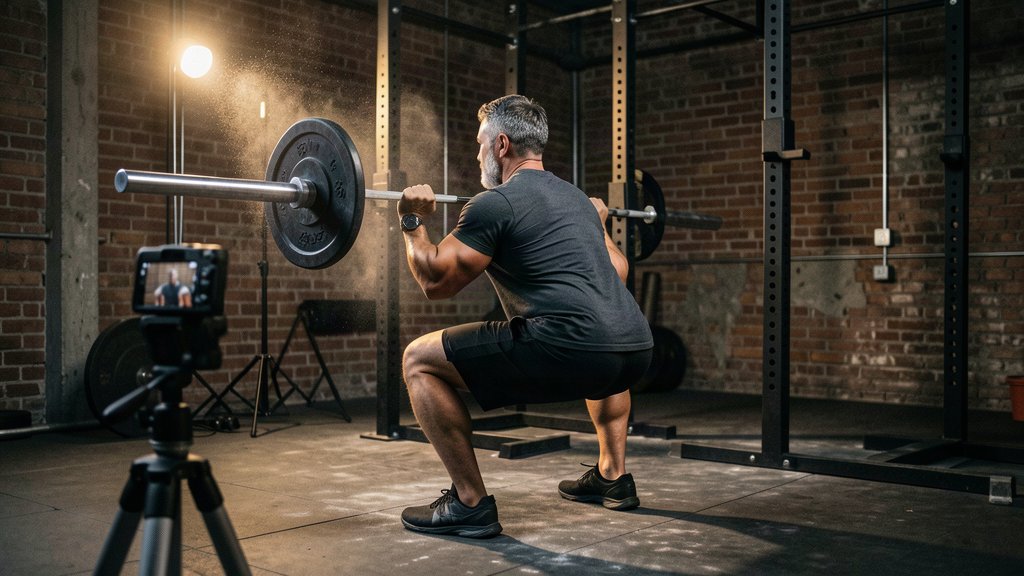
You filmed your squat tonight. You watched it twice. Then you deleted it. The bar wobbled, the depth was a polite maybe, and by rep four your lower back had taken over like it owned the place. You told yourself the camera angle was bad.
The camera angle wasn't bad. And the video isn't proof you're too old for this. It's proof of the real problem: you've been treating technique like decoration, and at 40+ it's the only asset that compounds. The lifter still pulling heavy at 60 isn't the gifted one. It's the one whose form held long enough to let the training run. Here's what actually changes, the per-lift standards, and how to fix it for real.
What Actually Changes for Technique After 40
Three things. None of them is "your body can't learn new movement."
Mobility becomes a training variable, not a birthright. Decades of desks shorten hips and ankles, and the squat that used to be waiting for you now has to be built. Fine. It's buildable: a 2026 meta-analysis of 79 trials found chronic static stretching improves lower-limb flexibility with a moderate effect, and age didn't meaningfully moderate the gains [2]. Stiff doesn't mean frozen. It means untrained.
The skill still learns. It just needs a different schedule. Motor-learning research is clear: in older adults, learning capabilities remain intact, with considerable performance gains from practice [1]. What matters in the gym: age differences show up in complex tasks, while in low-complexity tasks older adults learn about as well as anyone [1]. The squat is a complex task. You don't fix it in one heroic session. You fix it in chunks, across sessions, with sleep between them. Technique work is a weekly habit, not a seminar.
Heavy sets cost more, and the last reps pay for it. Fatigue eats precision before it eats strength. At 40+, a heavy set leaves less in the tank, so rep four wobbles not because you forgot the pattern but because it's running on fumes. Film the set, judge it, and cut it at the rep where the pattern breaks. That rep is your honest top. Past 50, the over-50 readiness guide covers the recovery side of this equation.
Breathing and Bracing Is the First Skill
Before stance, before grip, before anything: the brace. Stand tall, breathe into your belly, tighten everything, 360 degrees, like bracing to take a punch to the gut. Hold it through the rep. Exhale at the top, never at the bottom, never mid-lift.
Coaching practice, not studied protocol, but non-negotiable: brace first, move second. A belt gives the brace something to push against; it doesn't brace for you. Learn it beltless, add the belt for heavy sets. When your squat becomes a good morning, hips up first, nine times out of ten it's bracing, not strength. Check the brace before you blame the stance.
The Squat: Stance, Depth, Brace
The standard: hips and chest rise together, straight bar path, honest depth.
- Stance. Heels about shoulder-width, toes out 15–30 degrees. The classic 40+ error is a stance too narrow, which drives the knees forward and demands ankle range you may not have. Widen until you can hit depth without heels lifting. That's your stance. Not the one you used at 25. The one that works today.
- Depth. The competition standard is the hip crease below the top of the knee, and it has no age exemption. Not competing? Depth is still the strongest version of the squat: partial reps train partial movement, and the bottom is where the knee and hip earn their range. Depth drift is silent; film it.
- Brace. Set before the descent, held through it. The common 40+ error is re-negotiating at the bottom, breathing, relaxing, hoping. The bottom is for staying tight, not for starting over.
The Bench: Leg Drive, Setup, and the Wrong Answer at 40+
Setup first: eyes under the bar, feet planted flat, shoulder blades back and down into a modest, repeatable arch. Then leg drive: push your feet into the floor and your shoulders into the bench before the bar moves. The press starts from the legs. The common older-lifter error is a passive lower half, which turns the bench into an arms-only press with the lower back doing the talking.
Now the big arch, honestly. It shortens the range of motion and brings the legs into the lift; real advantages on the platform. But a big arch is thoracic extension on demand, every session, taxing the spine and the front of the shoulder. After 40, the cost-benefit inverts: the inches an extreme arch saves matter less than the spinal and shoulder load it adds across a training career. And a big arch with weak leg drive isn't a press. It's a layback.
Train a moderate arch you can hold for a paused set of five, get the leg drive real, and let the range of motion be what it is. If you compete and want the big arch, build it in meet prep, deliberately, for the spine and shoulders it costs. Coaching practice, honestly labeled.
The Deadlift: Stance, Start Position, and the Honest Sumo Conversation
The start position is the whole lift. Bar over midfoot, shins to the bar, lats packed, spine neutral. The classic error, paid for with interest at 40+, is standing too far back: bar forward of midfoot, the pull becomes a stiff-legged row with the lower back as the hinge. Pull the slack out before you pull the weight.
Stance choice: conventional, feet about hip-width, is the default. Sumo, feet wide, hands inside the knees, is a legitimate answer, not a shortcut. It's legal in every federation, shortens the pull, and spares the lumbar spine some flexion demand. It costs hip mobility and adductor strength, and switching stances is a new motor pattern needing six to eight weeks of patient work. You can do it; the learning is intact [1]. But if a rounded start is your problem, a wider stance won't fix it. Fix the position, then choose the stance.
Use Video Like a Coach, Not Like a Judge
The setup: camera at hip height, 45 degrees behind for the squat, direct side for the deadlift, side or front for the bench. Film the work sets, not the PRs. Review between sets, not after. Three things to look for: bar path (straight line over midfoot, no zigzag), position (the standard, or a negotiation), and symmetry (knees caving, hips shifting, one side doing more).
The rule: one cue per session. Fix three things in a session and you fix zero. Fix one per session and you've fixed a dozen in twelve weeks. Video is the mirror that makes chunked learning real: see one error, fix one error, come back tomorrow. When bar speed is the tiebreaker between clean and grind, that's RPE and bar-speed autoregulation.
Compete Against the Movement Standard, Not Your Ego
The movement standard is age-blind. Depth is depth at 25 and at 65. The pause is the pause. The lockout is the lockout. Judges don't weigh your birthday, and neither should you.
Ego is the most expensive hobby in the gym: a sloppy single at a weight that impresses nobody costs a week of recovery and teaches the wrong pattern. A clean rep at a weight nobody claps for teaches the pattern that still works at 60. Form is the asset that lets you train into your sixties: every clean rep is a deposit, every ego rep is a withdrawal with interest. Train the standard, and it will still be there when today's PRs are warm-ups. The complete after-40 guide is the full roadmap; this is the form piece inside it.
The Technique Checklist
- Brace 360° before every rep. Exhale at the top, never at the bottom.
- Squat: stance wide enough for depth without heel lift; hip crease below the knee; hips and chest rise together.
- Bench: shoulder blades set, feet planted, leg drive on every rep; arch moderate and repeatable.
- Deadlift: bar over midfoot, lats packed, neutral spine at the start. No yanking.
- Video: film the work sets, review between sets, one cue per session.
- Persistent joint pain, not soreness, is a warning sign: stop, see a professional. Training info, not medical advice.
If the squat setup is where your shoulders complain, the low bar squat fixes for stiff shoulders go deeper on grip, bar position, and alternatives. And when a joint goes from stiff to painful, the rules for when to stop lifting at the first sign of discomfort tell you which lever to pull.
Frequently Asked Questions About Powerlifting Form for Older Lifters
Is it too late to fix my technique at 45 or 55?
No. Learning capabilities remain intact in older adults, with real gains from practice [1]. What changes is the schedule: complex skills are learned in chunks across sessions, not in one fix-it night. You're not fighting age; you're fighting the one-session-fix-it habit.
Should I switch from conventional to sumo deadlift?
If hip mobility allows the start and conventional pulling has a chronic lower-back story, sumo is an honest option: legal everywhere, shorter pull, less lumbar demand. Budget six to eight weeks of technique reps. But no stance change fixes a bad start. Fix the start, then decide.
Is the big bench arch dangerous after 40?
Not dangerous by itself. It's a cost question: extreme thoracic extension taxes the spine and the front of the shoulder, and the ROM saved rarely pays for it at 40+. Train a moderate arch with real leg drive; save extremes for meet prep.
Why does my form fall apart on the last reps of a set?
Fatigue, not forgetting. The nervous system loses precision as a set grinds, sharper after 40. Cut the set where the pattern breaks and log that as your honest top. Clean reps are the training; the ugly rep is a withdrawal.
Outlast, Out-Program, Out-Recover
Here's the deal at 40: form is the only piece of the sport you can keep improving for twenty more years. PRs plateau, recovery gets noisier, but a clean rep stays a clean rep, and clean reps build the sixty-year-old in your future.
The catch: technique only holds when the bar is honest, when today's load matches today's readiness. A grind day teaches the wrong pattern. The Adaptive System exists for exactly this: the readiness engine adjusts the day's load by about ±5%, autoregulation keeps the last reps clean, the deload lands on week four, and joint load is tracked across the block. You lift. The system keeps the bar honest.
Stop guessing your intensity. Your form is too valuable to spend on a weight you weren't ready for. Start your 14-day free trial at app.cmstrength.fit/signup and let the programming keep the bar where your technique can hold it.
References
1. Voelcker-Rehage C. Motor-skill learning in older adults — a review of studies on age-related differences. European Review of Aging and Physical Activity. 2008;5(1):5–16. https://doi.org/10.1007/s11556-008-0030-9
2. Oba K, Matsuo S, Nakamura M, Nakao G, Fukaya T, Mizuno T, Takeuchi K. Moderating Effects of Individual Characteristics and the Target Lower Limb Muscle Group on Flexibility Adaptations to Chronic Static Stretching in Healthy Individuals: A Systematic Review and Meta-Analysis of Randomized Controlled Trials. Sports Medicine – Open. 2026. https://doi.org/10.1186/s40798-026-01066-1
Note on sourcing: the two studies above anchor the claims about motor learning and mobility. Setup standards, bracing method, camera placement, and stance guidance are coaching practice, honestly labeled, not peer-reviewed protocol.