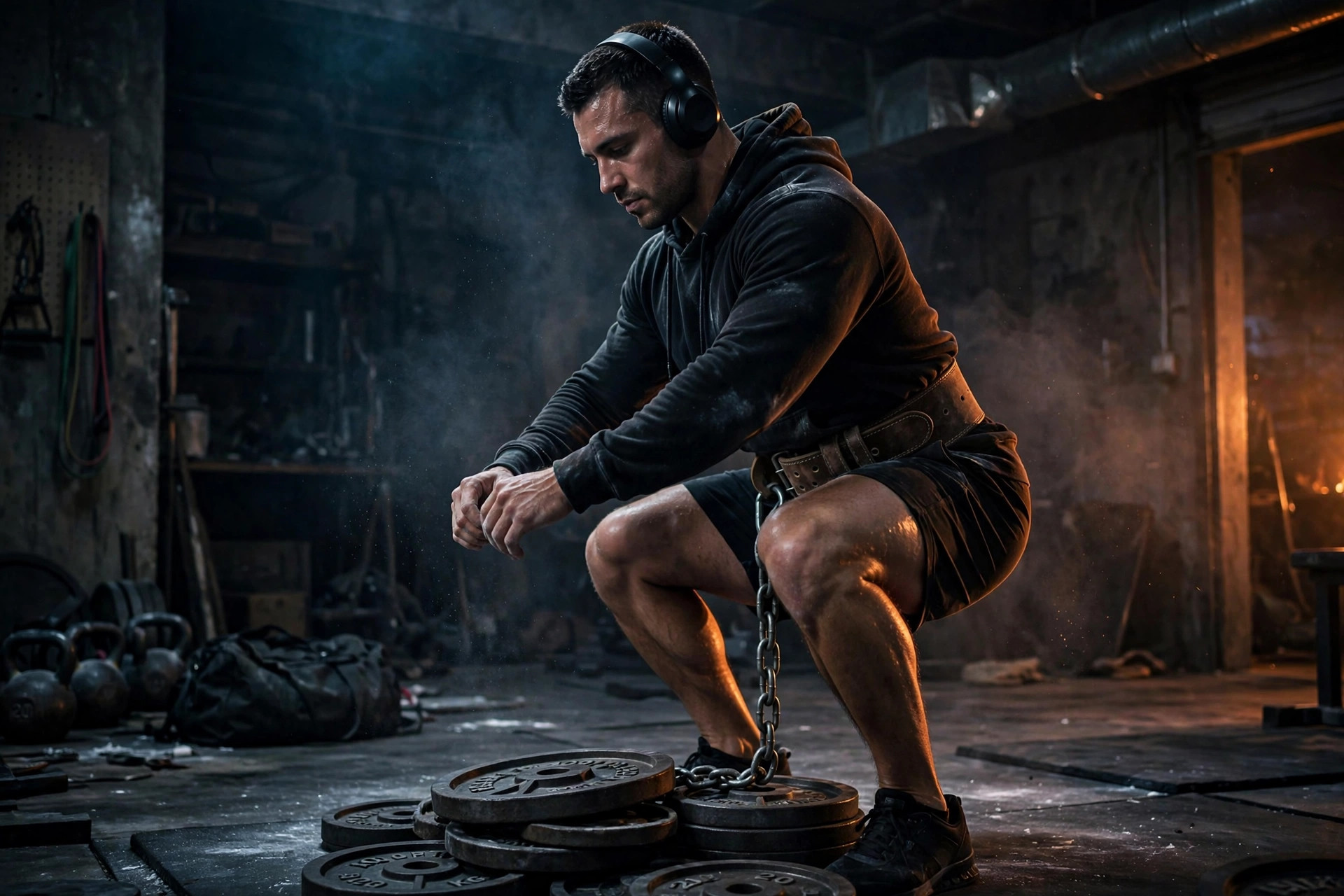
Why the Belt Squat Exists
Every heavy squat is two workouts in one: a leg workout and a spinal loading event. The legs are almost never the problem — the lower back is. Ask any lifter who's ground through a heavy squat block: the quads recover in two days, the back takes five. The volume your legs could handle is capped by the volume your spine can survive, and that gap is exactly why the belt squat exists.
The idea is simple to the point of obvious: hang the weight from your hips instead of stacking it on your back. A wide belt sits on your hip bones, a chain runs down from it, plates hang off the chain, and you squat while the load pulls straight down through your pelvis. The knees and quads get a full heavy squat pattern. The spine gets nothing — no compression, no shear, no bracing-against-a-maximal-load cost. It's the closest thing the iron world has to a free lunch.
This isn't a new invention. Lifters were hanging weights from hip belts decades ago — it's one of those old garage-gym ideas that never left because it kept working. Powerlifters discovered early that they could pile squat-pattern volume onto their legs without adding a single pound of fatigue to the lower back that had to recover for deadlifts. Rehabilitation-minded lifters discovered that it was the one heavy leg movement they could do while their backs were healing. And once purpose-built belt squat machines showed up in commercial gyms, the thing went from a workaround to a staple.
For a masters lifter, the math is especially clear. After 40, recovery is the program. The spine keeps score longer, backs get creaky between heavy barbell sessions, and the thing that keeps people out of the gym isn't weak legs — it's a back that's still talking from Monday. The belt squat doesn't replace the barbell squat. It lets you train the legs hard on days when the back would otherwise say no.
The barbell squat loads the legs through the spine. The belt squat loads the legs without it. Same legs, no toll.
What this guide covers: why the belt squat exists (spinal loading deloaded), how it works — belt, chain or lever, and the platform you stand on — the setup step by step, the mistakes everyone makes, the belt squat vs. barbell squat comparison with no agenda, programming (sets, reps, RPE, where it lives in the macrocycle, injury and comeback use), the belt squat after 40, and DIY options from a dip belt and boxes to lever machines. If you run CMS's SBD Full Powerlifting track, the engine slots belt squat volume into the weeks your back needs relief — secondary squat days, deload blocks, and comeback phases — so the legs keep growing while the spine recovers.
How It Works: Belt, Chain or Lever, Platform
Every belt squat setup has three parts, whatever flavor you use:
1. The belt. Not a weightlifting belt — a hip belt, wide and flat, that sits on the hip bones. A dip belt works (the chain goes through the front), purpose-built belt squat belts have attachment points front and back and spread the load wider. The belt has to sit low and tight on the hips — pelvis, not waist. If it rides up toward the ribs, every rep becomes an argument and the setup is wrong.
2. The connection. On the classic setup, it's a chain: belt to chain to plates, hanging straight down. On lever machines, the belt clips to an arm that pivots on the machine — you clip in, the arm takes the plates, and the machine does what the chain did, with less fuss and no clearance math. On a landmine or cable setup, the bar or pulley cable becomes the connection. Same principle in all of them: the load hangs from the hips and pulls down through the pelvis, never through the spine.
3. The platform. The plates have to hang in empty space. That means you stand on something — two boxes, two benches, a purpose-built platform, the machine's built-in stands — with a gap in the middle for the plates to swing free. The platform height is the clearance budget: tall enough that the plates never touch the floor through the whole rep, stable enough that you forget it's there. Wobbly boxes make every rep a balance drill, and that's not what you're here for.
Watch one heavy rep and the physics is obvious. The torso stays nearly upright — nothing on your back is trying to fold you forward — the knees track out over the toes, the hips sit straight down, and the quads do the work the way they do in a front squat: lots of knee travel, lots of knee extensor demand, minimal back involvement. It's the most knee-friendly, back-friendly squat pattern that still counts as heavy leg training.
The Setup, Step by Step
Do it the same way every time. The belt squat is simpler than a barbell setup, but it's not casual — a sloppy belt or a wrong chain length turns the movement into a different exercise than the one you think you're doing.
- Build the platform first. Two boxes, two benches, or the machine's stands — equal height, dead stable, with a gap wide enough that the plates and chain hang free without brushing the sides. Stand on it unloaded and bounce once. If anything shifts, rebuild it. The plates swinging into a box edge mid-rep is a small disaster you'll only cause once.
- Put the belt on like it matters. Sit the belt on the hip bones — low, on the pelvis — and cinch it tight. Tight enough that it won't ride up when the load pulls down. It should feel snug before any weight is attached; the chain's pull will test that snugness instantly. If your gym has a purpose-built belt squat belt, use it — wider hips contact, less pinch. A dip belt works fine for lighter and moderate loads.
- Set the chain length before you load. This is the whole setup, and there's a rule: the plates must hang free through the entire rep, never touching the floor and never going slack. Stand in position, hook the chain to the belt, and let the empty chain hang — the end should clear the floor at your deepest squat depth with a couple of inches to spare. Too long and the plates unload at the bottom (the hardest part of the rep gets a rest it didn't earn). Too short and you'll never reach depth. Test the length unloaded, then load it.
- Load the plates and step up. Put the plates on the chain's pin or loading post while you're standing on the ground, then step up onto the platform and clip in. Trying to load plates while clipped in and standing between two boxes is a comedy act with bad endings.
- Get stable before you descend. Feet roughly shoulder width, toes out a touch, hands on the rack uprights or the machine handles for balance — not for pulling. The hands are guides, not engines. Set your balance over the whole foot and feel the weight hang dead-center before you move.
- Squat straight down. Unlock the knees and hips together and sit down between your feet. The torso will stay nearly upright on its own — don't force it vertical with your lower back, and don't let it tip forward to chase quad burn. Knees track over the toes. Go as deep as your hips and knees allow; depth stops where the back stays neutral and the knees stay happy.
- Turn it around and drive. Reverse at the bottom without relaxing — the stretch reflex is still real here — and drive the floor away. At the top, don't over-arch or lean back; stand tall, weight centered, chain hanging straight down. One rep ends when you're standing, not when the hips twitch backward.
The first session should be embarrassingly light. Not because the movement is dangerous — it's the safest heavy leg exercise there is — but because the setup has a learning curve and the hip belt feels weird until it doesn't. Two sessions in, the mechanics will feel automatic, and then you can start loading it like you mean it.
The Mistakes Everyone Makes
Same mistakes, same gyms. The belt squat is simple, and simplicity makes people careless:
- The chain is too long. The single most common error. The plates kiss the floor at the bottom of the rep and unload — and the bottom is the rep. You're doing the hard part with less weight than you think, and the loading becomes a lie. Fix: shorten the chain until the plates hang free at full depth, with clearance to spare. Re-check the length whenever the platform height changes.
- The chain is too short. The other direction: you run out of depth because the chain goes taut three inches above the bottom. If your belt squat reps are shallower than your barbell reps, check the chain before you blame your mobility.
- The belt rides up. Belt too loose, or sitting too high on the waist instead of the hips. The load drags it up the torso and every rep pinches. Fix: cinch it down on the hip bones, tight enough that it can't migrate. If a dip belt keeps creeping, it's usually because it's sitting on the waist — drop it lower.
- Pulling with the hands. Hands are on the rack for balance, but watch people fatigue and the hands start helping — a little row with every rep. It unloads the legs and the person doesn't notice. Fix: hands as light as possible, fingertips if you can manage it. If you need the hands to get up, the weight's too heavy.
- Tiny range of motion. Half-reps on the belt squat are especially common because the exercise feels safe — so people load it like a leg press and move the plates four inches. The knee travel and deep hip flexion are the point. Fix: cut the weight until you can squat to your honest depth, the way the barbell squat guide demands of the back squat. Ego reps here build nothing.
- Treating it as a light pump exercise only. The belt squat became famous partly as a high-rep quad pump movement, and plenty of people never load it past that. But the movement handles real weight — heavy sets of 5–8 with plates swinging are completely legitimate, and that's where the strength carryover lives. Don't leave the heavy end of it on the table.
- Ignoring the hips on the belt. Some lifters clip the belt on and go. The belt will find your hip bones anyway, but ten seconds of adjusting — belt level, snug, sitting on bone not soft tissue — is the difference between a comfortable set and ten minutes of hip bruising.
Belt Squat vs. Barbell Squat, Honestly
Someone will tell you the belt squat replaces the barbell squat. It doesn't. Someone else will tell you it's a toy. It isn't. Here's the honest comparison, no agenda:
The read is straightforward. The barbell squat is the competition lift and the systemic strength builder — the back, the brace, the whole-body demand are part of what makes it valuable, and nothing replaces that for a powerlifter. The belt squat is the volume tool: more squat-pattern reps, more quad mass, more leg strength, with the spine sitting the whole thing out. A program that uses both gets the barbell's systemic demand and the belt squat's extra volume without doubling the spinal bill. A program that tries to swap one for the other either loses leg volume (dropping the belt squat) or loses the competition lift's back and bracing demands (dropping the barbell).
How to Program It
The belt squat is a secondary lift that earns primary respect. It takes volume beautifully, it never costs your back, and it slots into a program anywhere the legs need work and the spine needs a break.
Sets, reps, RPE. The belt squat's natural home is 3–5 sets of 8–15 reps at RPE 7–9 — the moderate-to-high rep work that builds quads and work capacity without a bracing cost. But don't confine it there: heavy sets of 5–8 at RPE 8–9 build real strength carryover to the barbell squat, and high-rep finishers (sets of 15–25) are the classic quad builder. Cap the top sets at RPE 9 like everything else. The legs can recover from a grinder here, but the knees and the belt interface prefer you don't make grinding a habit.
Where it lives in the week. The classic placement is the secondary squat day: barbell squat heavy early in the week, belt squat volume later in the week. The back recovers from the heavy day while the legs get a second session. It also pairs well as an accessory after deadlifts — the back is already worked, the legs aren't, and the belt squat threads that needle perfectly.
Where it lives in the macrocycle. In the accumulation block, when volume is king, the belt squat is the engine of extra squat-pattern reps — this is where it earns its keep, adding 8–15 working sets a week that the back never feels. In the strength block, it shifts to heavier, lower-rep work as a secondary. In the peak, it mostly disappears: specificity rules the last weeks, and every squat that matters is a barbell squat. And in deload weeks, it's the ideal placeholder — legs stay greased, the spine gets a true holiday. If the periodization guide's block structure is new to you, the short version: volume goes up early, intensity goes up late, and the belt squat does its best work in the volume phase.
Injury and comeback use. This is where the belt squat goes from useful to essential. Lower-back injury? The belt squat is often the first heavy leg movement that comes back, because the injury site isn't loaded. Shoulder injury that makes holding a barbell impossible — the busted-up shoulders in Low Bar Squat With Stiff Shoulders being the extreme case? The belt squat keeps the legs strong while the shoulders heal, with literally zero shoulder involvement. Coming back from any layoff, it's the re-entry vehicle: heavy leg work without the full-system demand of a barbell, until the body is ready for the real thing. Standard rules apply — this isn't medical advice, and a real back injury gets a real professional — but as a programming tool for training around problems, nothing beats it.
Volume math. Most lifters can add 8–12 hard belt squat sets a week on top of their barbell work without recovery complaints, because the limiting system — the lower back — isn't in the equation. That's effectively a free second squat day. If your squat has been stuck because your back can't recover from more volume, this is the unlocked door.
Belt Squat After 40
If there's a lift designed for masters lifters, it's this one. After 40, the recovery budget shrinks and the spine's opinion gets louder, but the legs still respond to hard work. The belt squat lets you give the legs the volume they need without spending the back's recovery budget. That one sentence is the whole case.
Practically, three things. First, it extends the heavy leg training life. Plenty of lifters hit the point where heavy barbell squats twice a week beat up the back more than they build the legs. Swapping one of those days for belt squat volume keeps the legs progressing while the back gets half the pounding. It's not giving up — it's spending the recovery where it pays.
Second, it's kind to knees and shoulders. The upright torso and natural knee tracking treat cranky knees well — deep, controlled reps with the joints tracking cleanly are usually better tolerated than people expect. And for the lifter whose shoulders veto the low bar position, the belt squat is a squat pattern with no shoulder requirement at all. The stiff-shoulders guide covers keeping the barbell position; the belt squat is the option when keeping it isn't in the cards for a while.
Third, warm up on it. Light belt squat sets before barbell squats are an excellent movement prep — hips, knees, and quads wake up under load without the spine getting involved, and the barbell work sets feel better for it. Two or three easy sets, full range of motion, and the joints are ready.
The full masters playbook — technique adjustments, recovery pacing, and which variations earn their keep across all three lifts — is in Powerlifting Form for Older Lifters.
DIY Options: Dip Belt, Landmine, Lever Machines
No belt squat machine in the gym? Fine. The DIY versions have been building legs for decades, and the best one costs about the price of a dip belt:
The dip belt and boxes (the classic). A dip belt, a chain, and two sturdy boxes or benches — that's the whole machine. Set the boxes far enough apart that the plates hang between them, clip the chain to the belt, step up, squat. This is how garage lifters have done it forever. The downsides are real but manageable: the dip belt can pinch at heavier loads (padding or a purpose belt fixes it), and chain-length fussing is part of the ritual. But for a home gym, this is a genuine belt squat, not a compromise.
The landmine belt squat. Anchor a landmine, slide the belt's attachment onto the bar sleeve (some lifters run the dip belt chain through it), stand on a platform straddling the bar, and squat against the landmine's arc. It's a belt squat with training wheels — the arc guides the movement and the landmine base gives you something to grab. Less natural than the hanging-chain version, more stable, and it lives in any gym with a landmine.
Lever-arm attachments. Several companies make belt squat arms that bolt to a power rack — you clip your belt to the arm, load plates on the arm's pegs, and squat. These split the difference between DIY and commercial: no chain fiddling, no platform geometry, a purpose-built belt usually included, and the whole thing folds away when the rack needs to be a rack again. For a home gym that has the rack but not the floor space for a standalone machine, this is the sweet spot.
The standalone machine. The real deal — platform, belt, lever arm, plate pegs, handles, all engineered. If your commercial gym has one, use it; it's the most comfortable version of the movement and the easiest to load heavy. Buying one for a home gym is a luxury, not a necessity — the dip belt version trains the same muscles.
The cable option. A low cable pulley with the stack, stood on two boxes, belt clipped to the cable. Constant tension through the whole rep (cables don't unload at the top the way plates slightly do) and infinite load adjustability. Works best for moderate reps; at very heavy loads the stack runs out and the cable geometry gets awkward.
Whatever version you build, the rules don't change: belt on the hips, plates hanging free the whole rep, full depth, hands for balance only. The machine is a convenience. The movement is the point.
Belt Squat: Common Questions
Is the belt squat as good as the barbell squat?
It's not the same thing, so "as good" is the wrong question. The belt squat builds leg strength and quad mass without loading the spine; the barbell squat builds total-body strength including the back, the brace, and the competition-specific skill. For a powerlifter, the barbell is irreplaceable. For leg volume, injury workarounds, and masters recovery budgets, the belt squat is unmatched. Run both and you get both.
How long should the chain be?
Long enough that the plates hang free through the entire rep — never touching the floor, never going slack. Too long and the plates unload at the bottom, which is the hardest part of the rep; too short and you can't reach depth. Set it unloaded first: clip in, squat to full depth, and check that the empty chain clears the floor by a couple of inches. Re-check whenever the platform height changes.
Can I do belt squats without a machine?
Yes — the original belt squat is a dip belt, a chain, and two boxes, and it works perfectly. The landmine version, rack-mounted lever arms, and low-cable setups are all legitimate too. The standalone machine is the most comfortable version, but the muscles don't know the difference. The DIY rule is the same as the machine rule: belt on the hips, plates free, full depth.
Will belt squats help my back pain?
The belt squat doesn't treat back pain — nothing in the gym does — but it lets you train legs hard without loading the spine, which is why lifters with back trouble keep it in the rotation. If you have an actual back injury, see a professional before programming around it. As a tool for keeping leg strength while a back heals, it's the best option in the gym.
How heavy can I go on a belt squat?
Heavier than you'd expect. The quads and glutes will be the limiter, not the setup — heavy sets of 5–8 with multiple plates swinging are completely standard. Load it like a real lift: work up to top sets at RPE 8–9, don't live at RPE 10. The belt interface (comfort on the hips) is usually the practical ceiling before the muscles are, which is another reason a good belt matters.
Where does the belt squat fit in a powerlifting program?
As the secondary squat day — barbell squat heavy early in the week, belt squat volume later — and as the volume engine in the accumulation block, where it can add 8–12 working sets the back never feels. It shines in deload weeks (legs stay greased, spine rests) and in comeback blocks after injury. It fades out in the peak: the last weeks belong to the competition barbell squat.