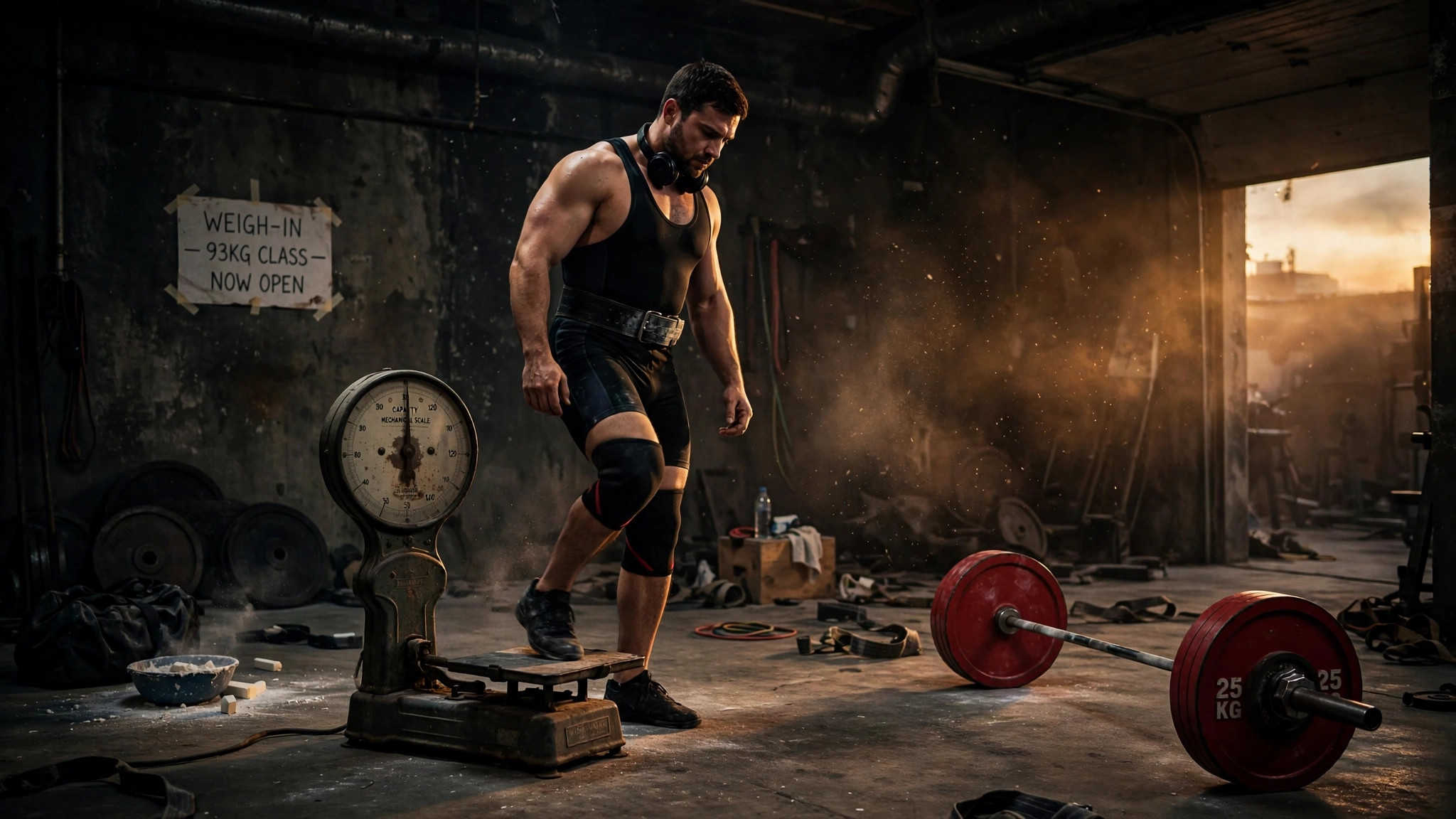
What Weight Classes Are (and Why They Exist)
Powerlifting is one of the only sports where the thing being measured has almost nothing to do with body size and everything to do with it anyway. The bar doesn't care how much you weigh — 200 kilos is 200 kilos — but a 130-kilo lifter will almost always out-total a 60-kilo lifter, because muscle moves weight and bigger people carry more muscle. Left undivided, the sport would be won by whoever is the biggest. Weight classes solve that. They slice the field into bodyweight brackets so you compete against lifters built like you, which is the only way a 66-kilo technician and a 120-kilo mountain can both be great at the same sport.
The classes aren't arbitrary. Body weight is the single best rough predictor of how much a human can lift, so the brackets put you in a fair fight without pretending size doesn't matter. Every federation runs its own class list — and they differ — but the classes that matter most are the IPF's, because the International Powerlifting Federation sets the standard that the big national federations (Powerlifting America, USAPL, and most of the world) follow. If you compete in a tested, drug-tested federation anywhere on the planet, you're probably lifting in IPF classes.
One confusion to kill early: weight classes are not age divisions. Your weight class is your bodyweight bracket (59 kg, 83 kg, 93 kg…). Your division is your age bracket (Junior, Open, Masters 1, and so on). You compete in both at once — a 45-year-old at 210 pounds is a Masters 1 lifter in the 93-kilo class. Classes answer "how big is your body," divisions answer "how old is it." They're independent, and you don't get to pick the second one.
What this guide covers: why weight classes exist, every IPF weight class for men and women (the 2026 lists, including the new women's classes), how the weigh-in actually works (timing, rules, what happens if you miss), how to pick your class — the honest version — the case for filling out a class instead of cutting into one, when a water cut is actually worth it and the 5% rule that governs it, how to grow into your class over a training career, and the five mistakes lifters make with weight classes. If you train in CMS's SBD Full Powerlifting track, bodyweight is one of the inputs the engine watches: your nutrition and weight trend get factored into the programming so the mass you're carrying is actually turning into kilos on the total.
Every IPF Weight Class (2026)
The IPF runs eight classes for men and eight for women. You weigh in once, and you lift in the class your bodyweight lands in — if you weigh 82.4 kilos you lift in the 83-kilo class; if you weigh 83.1 you lift in the 93-kilo class. There is no rounding down, no mercy, no "close enough." The scale is the final word, and it reads to the decimal.
Men (2026 IPF):
- Up to 53.0 kg — sub-junior and junior only
- 59.0 kg class — up to 59.0 kg
- 66.0 kg class — 59.01 to 66.0 kg
- 74.0 kg class — 66.01 to 74.0 kg
- 83.0 kg class — 74.01 to 83.0 kg
- 93.0 kg class — 83.01 to 93.0 kg
- 105.0 kg class — 93.01 to 105.0 kg
- 120.0 kg class — 105.01 to 120.0 kg
- 120.0+ kg class — 120.01 kg and up (the superheavyweight)
Women (2026 IPF):
- Up to 43.0 kg — sub-junior and junior only
- 47.0 kg class — up to 47.0 kg
- 52.0 kg class — 47.01 to 52.0 kg
- 57.0 kg class — 52.01 to 57.0 kg
- 63.0 kg class — 57.01 to 63.0 kg
- 69.0 kg class — 63.01 to 69.0 kg
- 76.0 kg class — 69.01 to 76.0 kg
- 84.0 kg class — 76.01 to 84.0 kg
- 84.0+ kg class — 84.01 kg and up (the superheavyweight)
Note the women's list changed recently. The 2026 update replaced the old 72-kilo class with 69 and 76, so if you're reading an older chart that still shows 72, it's stale. The men's classes have been stable for years. Always check your federation's current rulebook before you plan around a class — local federations occasionally run their own variations, and "the internet said" doesn't survive a weigh-in.
Here's the pattern to notice: the classes get wider as they get heavier. Down low the gaps are 6–7 kilos; up top they're 12–15. That's because a 5-kilo difference is a big deal at 59 kilos of bodyweight and barely a rounding error at 120. The bracket spacing reflects how bodyweight actually scales with strength — it's roughly logarithmic, like everything else in this sport that turns out to be smarter than it looks.
Your class isn't the weight you're trying to reach. It's the weight you already are, at your strongest.
How the Weigh-In Actually Works
The weigh-in is where your class gets decided, and the rules are stricter than most lifters expect the first time. You weigh in during a window before the lifting starts. At local meets that's usually a 24-hour weigh-in — you can weigh in the day before and rehydrate/re-feed before you lift. At IPF-level competition it's a 2-hour weigh-in — you weigh in two hours before your session and lift at roughly the weight you weighed. This single difference is the entire reason cutting advice from elite lifters doesn't apply to your local meet, and the entire reason local-meet cutting advice doesn't apply at nationals. Know which weigh-in you're walking into.
The mechanics: you step on the scale, usually in your underwear or your singlet, and the number is recorded to the tenth of a kilo. You weigh in once — one official attempt — and whatever it reads is your bodyweight for the day. If you're over your intended class, you can usually re-weigh within the window if time permits, but nobody wants to spend weigh-in morning sweating in a sauna suit behind the venue. The lifters who treat the class as "whatever I weigh that morning" sleep better and lift better.
One more rule people discover too late: you must weigh in at or below the top of your class, but there's no minimum. A 70-kilo lifter can lift in the 93-kilo class if he wants — he'd just be giving away 23 kilos of bodyweight to everyone in it, which is a donation, not a strategy. This is the rule that makes "bulking through a class" safe: if you outgrow your class mid-prep, you just lift in the next one up. The scale doesn't punish growth. The only direction that's dangerous is down.
How to Pick Your Class: The Honest Version
Here's the rule for your first meet, and it's non-negotiable: compete at your walk-around weight. Do not cut. Do not "lean out for the meet." Show up at the weight you normally are, lift in whatever class that lands in, and total. Your first meet is a data-gathering mission — you need attempts, a total, and the experience of the platform, not a compromised training peak and a miserable weigh-in. Cutting for your first meet is paying full price for a worse experience.
After that, the strategy gets real. The class you belong in is the heaviest class you can fill out with mostly muscle. "Fill out" means your bodyweight sits within a few kilos of the top of the class, year-round, without you thinking about it. If you're a 5'10" guy walking around at 88 kilos, you're a 93-kilo lifter — not an 83-kilo lifter with a cutting problem. The gap between the bottom of a class and the top is 7–12 kilos of bodyweight, and that's mostly 7–12 kilos of muscle you don't have. Filling a class is a multi-year project of eating and training; it is the single highest-leverage thing a developing lifter can do, and it's the opposite of glamorous.
The frame test helps: look at your height and your bone structure. Taller lifters with big frames belong in heavier classes — a 6'2" lifter has no business in the 74-kilo class, and the lifters who try anyway end up looking like greyhounds and lifting like them. The strongest lifters in any class tend to be the ones who are short for it — they're the most muscular at that bodyweight. You can't change your height, but you can stop fighting it. Pick the class your skeleton wants.
And masters lifters, this one's for you: after 40, aggressive cuts cost more than they buy. Your recovery budget is the limiting factor in everything now, and a hard water cut the week of a meet is a direct withdrawal from it. The evidence on creatine, protein, and muscle preservation all points the same direction — protect the tissue, feed the work. Lift at walk-around weight, or at most a couple of kilos under it, and put the energy you would have spent cutting into your peak. The scale is not the competition. The total is.
Filling Out vs. Cutting Down
There are two ways to land in a weight class: be that weight, or arrive at it. Filling out means growing into the class over months and years — you're 80 kilos, you want to be a 93-kilo lifter, so you eat in a smart surplus, train hard, and show up at 90–93 kilos a year later with more muscle everywhere. Cutting means you're 96 kilos, the meet is in two weeks, and you're going to be 93.0 on the scale through water manipulation and misery. One of these builds your total. The other borrows against it.
The math is simple. Muscle moves weight, and a cut doesn't add muscle — at best it doesn't lose any. A lifter who fills out the 93-kilo class over two years arrives with maybe 8 more kilos of lean mass than the lifter who cuts from 96 to 93. Same class, wildly different totals. This is why the advice "pick the lightest class you can make" is backwards for everyone who isn't already at the elite level: it optimizes for a smaller number on the scale instead of a bigger number on the bar, and the bar is what gets medals.
That doesn't mean cuts are always wrong. A cut is a legitimate tool in exactly one situation: you're already competitive in a class, you're a few kilos over the top of it, and the cut is small enough that it costs you nothing on the platform. That's the 5% rule — if the cut is more than about 5% of your bodyweight, the performance cost starts showing up in your total, and the research on rapid weight loss in strength sports backs this up: strength drops, especially in the upper body, and it doesn't fully come back in 24 hours. A 90-kilo lifter cutting to 83 is a 7-kilo cut — that's nearly 8%, and it's going to cost kilos off the total. A 95-kilo lifter cutting to 93 is a 2-kilo cut — that's a big dinner and a morning weigh-in, and it's free.
Run the decision like this: could you make the class by skipping breakfast and weighing in light? Then it's not a cut, it's timing. Would it take a week of water loading, salt manipulation, and sauna sessions? Then you're spending recovery and focus on the scale instead of the platform, and unless there's a record or a podium on the line, it's a bad trade. The lifters who cut the most are usually the ones with the least to gain from it — developing lifters chasing a class they haven't earned yet, instead of building the body that earns the next one up.
Every kilo you cut is a kilo of muscle you didn't build. Spend your off-seasons growing into classes, not your meet weeks shrinking into them.
Growing Through the Classes Over a Career
Zoom out and the weight-class game becomes a career arc, not a meet-week decision. Almost every great lifter has moved up classes over their career — they started light, filled out, got strong, outgrew the class, and moved up. The 74-kilo junior becomes the 83-kilo open lifter becomes the 93-kilo masters lifter, and the total climbs the whole way because the bodyweight climbs with the muscle. This is normal. This is the sport working as designed.
The practical version: pick a class you can fill out now, train and eat until you're pressing against the top of it, and when your walk-around weight has lived 2–3 kilos over the top for a few months, stop fighting it and move up. Don't force it with a dirty bulk — a kilo or two of quality bodyweight a year is a great pace once you're past the beginner stage. The lifters who rush this end up carrying 10 kilos of bodyweight that doesn't move the bar, and then they're stuck: too heavy for the old class, too soft for the new one.
And if you're a masters lifter reading this while your bodyweight has opinions of its own: the classes are still the same game, but the currency changed. After 40, every kilo of bodyweight should be earning its keep as muscle, because the joints are keeping score now. Fill your class with training, not with dessert. The 93-kilo class full of muscle at 45 beats the 105-kilo class full of regret — the total knows the difference even if the mirror is polite about it.
The Five Mistakes Lifters Make With Weight Classes
1. Cutting for the first meet. Covered above, worth repeating: your first meet is for learning, not for optimizing. Show up, weigh in, total, learn the commands. The class will still be there next time.
2. Picking a class from a chart instead of a mirror. The chart says a 5'6" lifter "should" be in the 74-kilo class. If that 5'6" lifter has the frame of a fire hydrant and walks around at 84 kilos of dense muscle, he's an 83-kilo lifter and the chart can mind its own business. Height-to-weight ratios are population averages; you're a sample of one.
3. Living at the bottom of a class. Weighing 84 kilos and lifting in the 93-kilo class means you're spotting the field up to 9 kilos of bodyweight. Sometimes that's temporary — you're growing into it — but if you've been at the bottom of a class for two years, that's not a class, that's a waiting room. Either fill it or drop down.
4. The forever cut. Some lifters spend their entire career 5 kilos over their class, cutting for every meet, never once training at the weight they compete at. They've turned a one-week tool into a lifestyle, and the lifestyle costs them every single peak. If you're always cutting, your class is wrong. Move up, fill it out, and watch what happens to your total when you train fed for a year.
5. Chasing superheavyweight. The 120+ class looks like freedom — no weigh-in stress, eat whatever you want. In practice it's where totals go to get weird: the class has no top, so you're competing against 150-kilo and 180-kilo lifters, and the bodyweight that doesn't add muscle just adds joint stress and health risk. Unless your frame genuinely supports 130+ kilos of mostly muscle, the superheavyweight class is a trap with good marketing. The capped classes exist for a reason.
Weight Classes and Your Training
Here's where the class decision touches your programming: your bodyweight trend is training data. If you're trying to fill out the 93-kilo class and your weight hasn't moved in six months, your surplus isn't a surplus — the food log is lying or the expenditure is higher than you think. If your weight is climbing a kilo a month and your total is flat, you're adding bodyweight that isn't muscle, and the surplus is too aggressive. The scale and the bar are two dials on the same machine; when they disagree, believe the bar and adjust the food.
This is also why the "recomp forever" plan fails lifters with class ambitions. Body recomposition — building muscle while holding bodyweight steady — works, but it's slow, and it works best for beginners and detrained lifters. If you've been training for years and you want to fill out a heavier class, you need a real surplus, not a hopeful one. Two to three hundred calories over maintenance, protein at 1.6–2.2 grams per kilo, patience measured in quarters. The class fills on the schedule muscle grows on, which is to say: slower than you want, exactly as fast as it works.
For the cutting-curious: if you do cut, do it with water, not with food. A proper water cut manipulates water and sodium over the last week — loading water early, cutting it late, dropping carbs to shed glycogen-bound water — while calories and protein stay up until the final days. You are not "dieting into the meet." You are temporarily dehydrating, then rehydrating after the weigh-in, which is exactly why a 24-hour weigh-in makes cuts viable and a 2-hour weigh-in makes them reckless. Never cut with a sauna as plan A, never cut more than 5%, and never cut for the first time at an important meet. Practice the protocol at a local meet where the stakes are a $40 entry fee, not your qualifying total.
--- ## CTA **Section-label:** COMPETE AT YOUR STRONGEST **Headline:** Your class should fit your body. Your program should fit your class. **Sub:** The SBD Full Powerlifting track factors your bodyweight trend into the programming — surplus phases timed to fill out your class, nutrition targets that build the right kilos, and peaking that never asks you to cut what you just built.