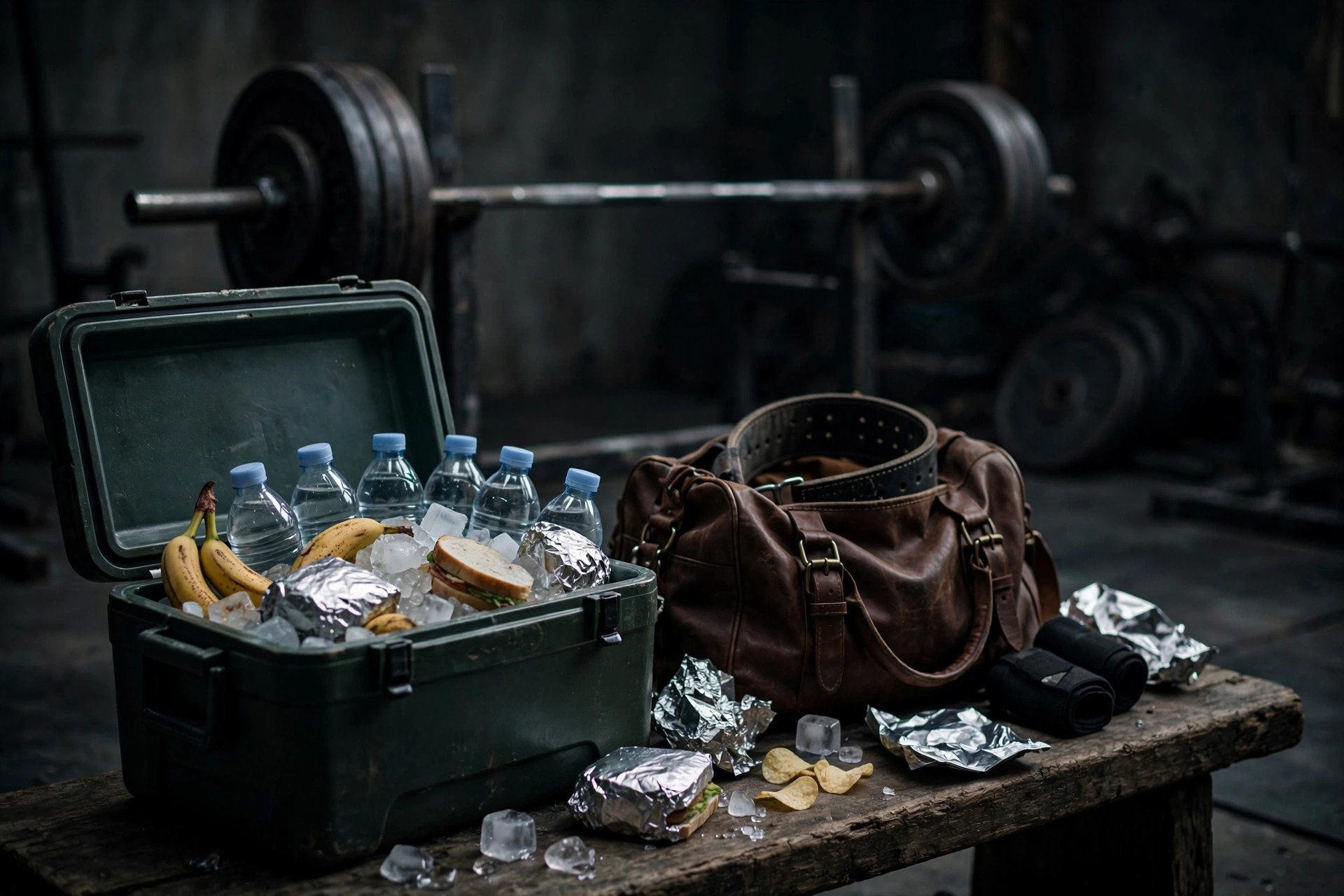
A powerlifting meet is not a training day. It’s an 8- to 10-hour event: weigh-ins (usually two hours before lifting starts), three flights of squats, then bench, then deadlifts, with long dead stretches between attempts and between lifts. Nine total attempts spread across most of your waking Saturday.
Most lifters plan their attempts down to the kilo and give zero thought to what they’ll eat between now and deadlifts. Then they wonder why their deadlift opener feels like a third attempt. Eating like a normal training day doesn’t work at a meet — and neither does starving until weigh-ins and then inhaling a giant meal. Here’s the playbook.
The Night Before and the Morning Of
The night before the meet, eat like a normal evening: a real dinner with carbs and protein, something you’ve eaten a hundred times. This isn’t the night to carbo-load like you’re running a marathon, and it definitely isn’t the night for a five-pound burrito. Your job is to wake up with full glycogen and a calm stomach [3].
Breakfast is the same principle. Eat what you’d eat on a heavy training morning — carbs plus some protein, nothing new, nothing fancy. Oatmeal and eggs, toast and peanut butter, whatever your body already knows how to handle at 7 AM. Avoid huge fiber or fat loads: they slow digestion and sit heavy, which is the last thing you want when squats start in a few hours [2].
If you cut weight to make a class, rehydration and refeeding after weigh-ins is its own discipline. Get fluids and easy carbs in immediately, then let your stomach settle before eating bigger. But even if you didn’t cut — most lifters don’t — breakfast matters, because the clock is already ticking on a very long day.
Between Attempts: Eat Small, Eat Steady
Once lifting starts, your strategy is simple: keep fueling light and steady for the entire meet. Your body is burning through glycogen for 8-plus hours, and carb intake during long efforts can help maintain performance when stores run low [1][3].
The gap that kills people is the dead time between lifts. The stretch from the end of squats to the start of bench, and from bench to deadlifts, is when lifters stop eating, get distracted, and fade. Set a mental timer: every hour or so between flights, get something in you.
What works:
- Bananas. The classic for a reason — portable, carb-rich, easy on the stomach.
- Sandwiches. PB&jelly or turkey. Pre-made, foil-wrapped, eat half between flights.
- Rice cakes and granola bars. Boring, reliable carbs. This is a feature, not a bug.
- Sports drinks. Carbs and electrolytes in liquid form — sip steadily between flights.
Think grazing, not meals. A half sandwich here, a banana there, sips of sports drink throughout. You want a steady trickle of energy, not a food coma at the exact moment you need to brace under a loaded bar.
The Nothing-New Rule
This is the single most important rule of meet-day nutrition: eat nothing on meet day that you haven’t already tested in training.
Not a new pre-workout. Not the diner breakfast across from the venue. Not the energy gel your buddy swears by. Not a new snack from the concession stand. Every food in your cooler should be something your stomach has handled before, ideally on a heavy training day.
New foods can mean new digestive surprises, and “digestive surprise” is a polite way to say your meet is over. The meet is the worst possible time to learn that a certain protein bar gives you cramps, or that a new pre-workout makes you jittery at 400 pounds. Run your full meet-day menu on a long training Saturday first. If it works there, it’ll work at the meet.
Caffeine: Dose It Early, Then Stop
Caffeine helps performance — that part is well established [1][2]. But meet day is not the day to get creative with it. Use exactly what you’ve trained with, at the doses you’ve trained with.
Timing matters more than people think. A meet runs all day, and caffeine’s half-life is several hours. Dose early — before squats, maybe a top-up before bench — so you’re sharp for the morning lifts without riding a stim wave into the evening. Adding a second stack or a heavy energy drink late in the day is how you end up jittery, shaky, and crashed right when deadlift singles come around.
The same goes for the candy-and-pre-workout survival plan. Living on Sour Patch Kids and stimulants for eight hours is not fueling — it’s a blood-sugar rollercoaster that ends in a bonk. Use caffeine as the tool it is, dosed early and modestly, and let real food do the actual work.
Hydration: Steady, Not Extreme
You don’t need a hydration science project on meet day. You need water, all day, steadily.
Sip water from the moment you wake up. Add electrolytes through a sports drink or salty food — you’ll be sweating under a warm venue’s lights for hours, and plain water alone across a 10-hour day isn’t the plan [2]. But don’t overdrink to the point where you’re sloshing; chugging a liter right before deadlifts is its own kind of discomfort.
Small, frequent sips. Same as the food: steady beats heroic. (A full hydration and electrolyte guide is coming as its own post — this is the meet-day version.)
The Mistakes That Cost Deadlifts
Almost every meet-day nutrition disaster is one of these:
- Fasting until weigh-ins, then eating a giant meal. Your stomach can’t handle a feast two hours before squats. Refeed after weigh-ins, but build up — fluids and easy carbs first, real food second.
- Surviving on candy and pre-workout. Sugar spikes, stim crashes, and zero actual fuel by hour six. Deadlift opener feels like a funeral.
- Eating nothing and bonking on deadlifts. The most common one. You were too nervous to eat during squats, too busy during bench, and by deadlifts your tank is empty. Set the timer. Eat anyway.
- Trying new supplements at the meet. The new pre-workout, the new creatine timing, the “secret” your training partner gave you in the warm-up room. No. Nothing new on meet day.
- Relying on the venue. Concession stands run out, have nothing useful, or are a 20-minute walk away. Everything you need should be in your cooler, in your bag, on your bench.
Pack the Cooler
Here’s the concrete version of everything above. Pack it the night before:
- Bananas (4–6)
- 2–3 sandwiches, pre-made and foil-wrapped (PB&jelly, turkey — whatever you’ve tested)
- Rice cakes or granola bars (4–6)
- 2–3 liters of water
- A sports drink or electrolyte option
- Whatever caffeine you trained with — measured, planned, early-dosed
- Something salty you like, for later in the day
Bring more than you think you’ll need. A meet always runs longer than the schedule says.
The Takeaway
Meet-day nutrition is logistics, not a science project. Pack the cooler, eat early and steadily, dose your caffeine before noon, drink water all day, and eat nothing you haven’t already tested in training. Save the experimenting for the gym. On meet day, boring food and steady fuel are what let the training you actually did show up when the bar is loaded.
References
- Kerksick, C.M., et al. (2017). ISSN Position Stand: Nutrient Timing Revisited. Journal of the International Society of Sports Nutrition. doi: 10.1186/s12970-017-0189-4
- Thomas, D.T., Erdman, K.A. & Burke, L.M. (2016). Position of the Academy of Nutrition and Dietetics, Dietitians of Canada, and the American College of Sports Medicine: Nutrition and Athletic Performance. Journal of the Academy of Nutrition and Dietetics. doi: 10.1016/j.jand.2015.12.006
- Burke, L.M., Hawley, J.A., Wong, S.H.S. & Jeukendrup, A.E. (2011). Carbohydrates for Training and Competition. Journal of Sports Sciences. doi: 10.1080/02640414.2011.585473