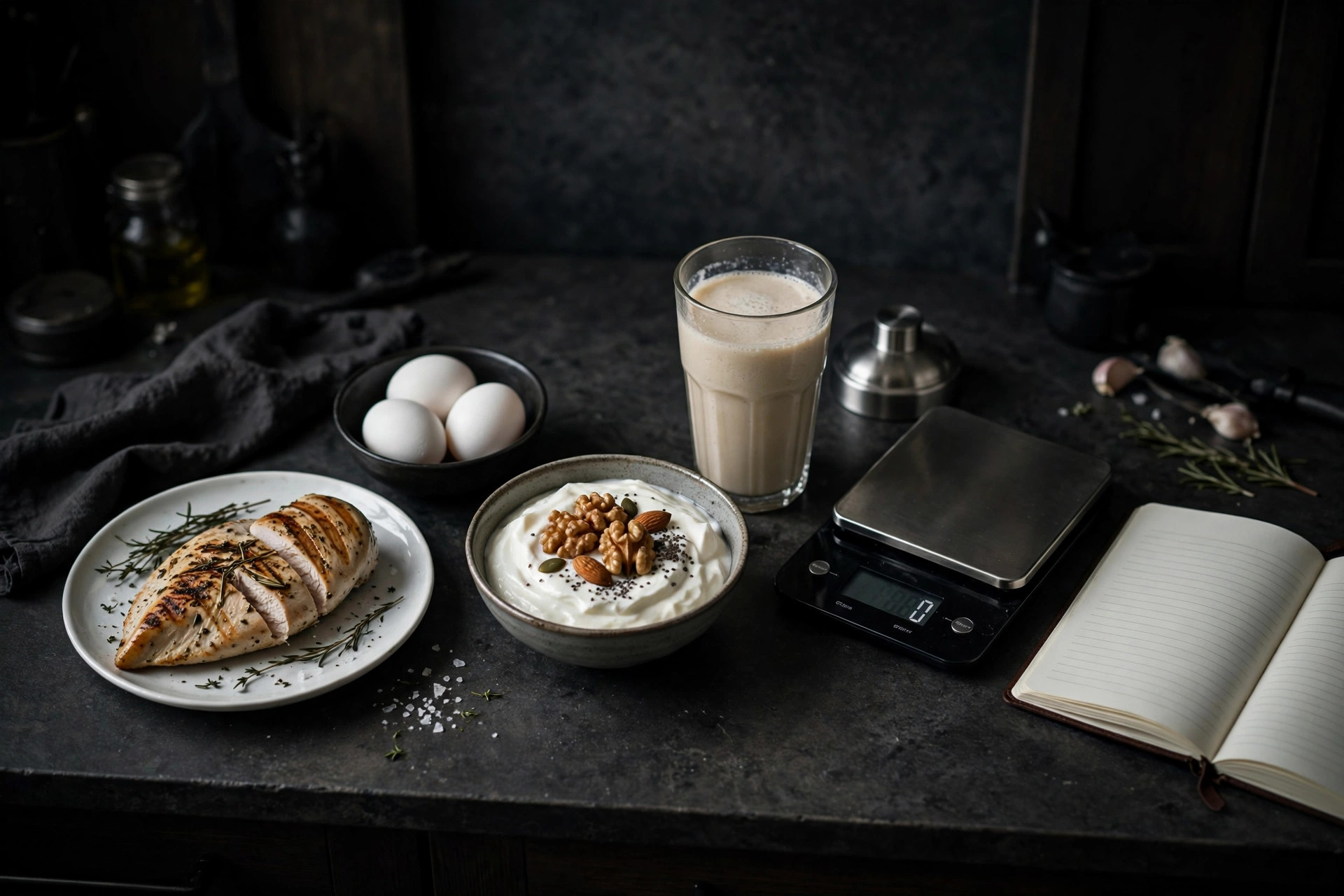
Most powerlifters get the protein conversation backward. They eat a steak the size of a shoe after training, skip protein at breakfast, and wonder why their total hasn’t moved. The problem isn’t how much protein you’re eating in a day — it’s that nobody’s looking at how it’s spread out or timed around the work that actually builds the muscle.
Here’s the plain version: get enough total protein, spread it across your meals, and don’t overthink the post-workout window.
How Much Protein You Actually Need
Forget the gym-bro rule of “a gram per pound, no exceptions.” Research on strength athletes consistently lands in the same range: 1.6 to 2.2 grams of protein per kilogram of body weight per day for people training hard with resistance work. For a 200-lb lifter, that’s roughly 145 to 200 grams per day.
That’s the range where strength and muscle gain are supported. Going higher — the classic 300-grams-a-day bro diet — doesn’t buy you anything except expensive grocery bills and a lot of chewing. Going under 1.6 g/kg while you’re in a building phase or running heavy blocks is where progress quietly leaks out.
If you’re a masters lifter, lean toward the top of that range. The older you get, the more protein your body needs to trigger the same muscle-building response — your body gets a little less sensitive to the signal, so you send a louder one.
Quick math for common body weights:
- 175 lb (80 kg): 128–176 g/day
- 200 lb (91 kg): 145–200 g/day
- 225 lb (102 kg): 163–224 g/day
- 250 lb (113 kg): 181–250 g/day
Pick your target, weigh your food for a week so you actually know where you land, and adjust from there.
Per-Meal Distribution: The Part Everyone Skips
Your body builds muscle in pulses, not in one continuous stream. Each time you eat a sufficient amount of protein — generally 0.3 to 0.5 g/kg per meal, roughly 25–45 grams for most lifters — you trigger a round of muscle protein synthesis. That pulse lasts a few hours, then fades.
Eat 10 grams of protein at breakfast and 120 grams at dinner, and you got one good pulse out of two meals. Eat 40 grams at four meals, and you got four. Same total, different result.
Practical layout:
- Breakfast: 35–45 g (this is where most lifters fail — coffee and a bagel isn’t fueling anything)
- Lunch: 35–45 g
- Pre-training meal: 25–40 g
- Post-training meal: 35–45 g
Four feedings across the day keeps you in the building zone more often. Three works fine if the portions are right. Two giant meals and a bunch of snacks is the pattern that underperforms.
Timing Around Training
The old “you must drink a shake within 30 minutes or your workout was wasted” rule is mostly dead. The window is wider than anyone admitted in 2008. If you ate a decent protein meal 2–3 hours before training, your body still has amino acids circulating when you finish — the exact minute you eat afterward matters very little.
That said, timing still has a role:
- Before training: A real meal 2–3 hours out with 25–40 g of protein. If you train first thing in the morning, something small 30–60 minutes before — a shake, Greek yogurt, a banana with protein — beats training fasted on an empty tank.
- After training: A normal protein-rich meal within a couple of hours. Nothing exotic required. The whole-food dinner with 40 g of protein does the job a $6 shake does.
The consistent pattern matters more than the clock. Lifters who train fed, recover fed, and eat on schedule get more out of the same program than lifters who nail one “perfect” post-workout shake and eat randomly the other 22 hours.
What Counts: Protein Sources
Don’t make this complicated. Animal sources — meat, eggs, dairy, fish — are complete and dense; they do the most work per bite. If you eat plant-based, combine sources (rice + beans, lentils + grains) and aim for the top of the daily range, since plant protein tends to be less efficiently used.
The supplement you actually need is whatever gets your total into range. A whey shake is cheap, convenient protein — not magic. If you’re hitting your daily number with food, you don’t need a single scoop. If work keeps you from eating until 2 PM, a shake in the morning is the difference between a building day and a wasted one.
The Takeaway
Protein is the simplest variable in your whole training equation. Hit 1.6–2.2 g/kg per day, spread it across 3–4 meals with 25–45 g each, eat like you mean it around training, and move on. Stop treating nutrition like a research project and start treating it like a program variable: set the target, run it for a block, and adjust based on what’s actually happening to your bodyweight and your lifts.