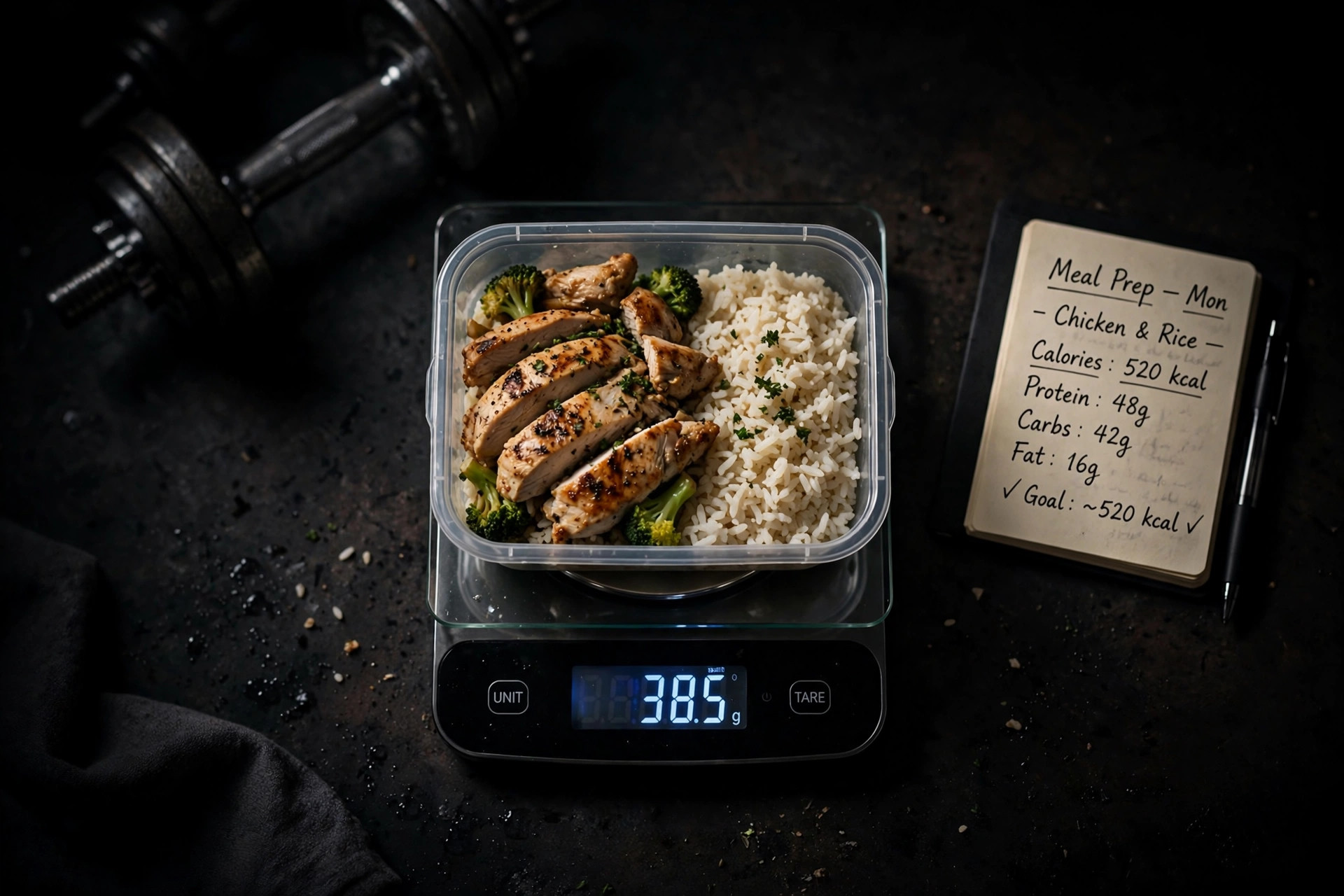
You can’t manage what you don’t measure. Lifters will track every set, rep, and RPE in their program, then guess their food by vibes — and wonder why bodyweight does whatever it wants. TDEE (Total Daily Energy Expenditure) is the number that takes the guesswork out. It’s how much energy your body burns in a full day, and it’s the anchor every nutrition decision hangs on.
What TDEE Actually Means
Your daily energy burn breaks into four pieces:
- BMR — Basal Metabolic Rate. The cost of keeping you alive: breathing, brain, organs. About 60–70% of the total for most people.
- NEAT — Non-Exercise Activity Thermogenesis. Everything that isn’t formal exercise: walking to the truck, standing at work, fidgeting. This varies enormously between people and is the biggest hidden lever in TDEE.
- TEF — Thermic Effect of Food. The energy cost of digesting what you eat, roughly 10% of intake.
- EAT — Exercise Activity Thermogenesis. Your actual training. For a powerlifter, this is a few hard hours a week — meaningful, but smaller than most lifters think. Heavy training burns less than people estimate and a lot less than the cardio apps tell you.
Add them up and you get TDEE: the number of calories where your weight stays put. Eat above it, you gain. Eat below it, you lose. Everything in fueling the work starts here.
How to Estimate It
The best method is also the simplest: track and respond. Weigh yourself daily for 2–3 weeks, track your calories honestly over the same period, and see which way the scale trends. If weight is flat, your intake equals your TDEE. If it’s dropping, your intake is below TDEE by however much the drop implies. That’s the real number for your body, your job, and your training — no formula needed.
If you want a starting estimate before you have data, multiply your bodyweight in pounds by 14–16 for a moderately active lifter and 16–18 if you’re training hard 4–6 days a week plus an active job. A 220-lb lifter training 4 days a week lands around 3,080–3,520 calories. That’s a starting point, not a prescription — run it for two weeks and let the scale correct you.
Activity trackers and their calorie burn numbers aren’t the tool for this. Watches routinely overestimate lifting calories by wide margins, and they don’t measure the biggest variable — NEAT. A desk worker and a contractor can lift identical programs and have TDEEs a thousand calories apart because one of them is on their feet all day. The scale and your food log beat the algorithm every time.
Using TDEE to Set Your Calories
Once you know (or have a working estimate of) your TDEE, the decision is simple:
- Building muscle (surplus): TDEE + 200–300 calories. Enough to support growth, small enough that the gains are mostly muscle. The scale should creep up roughly 0.25–0.5% of bodyweight per week.
- Losing fat (deficit): TDEE − 300–500 calories. That’s roughly 0.5–1 lb per week — about 0.3–0.5% of bodyweight for most lifters — without tanking your training.
- Recomposition (maintenance): eat at TDEE and let training drive the change. Slowest route, but real for lifters who qualify for it — newer lifters, lifters returning from a layoff, and lifters with plenty of fat to lose.
TDEE isn’t a fixed number. As you gain weight, it drifts up. As you diet down, it drifts down — and NEAT quietly drops when you’re in a deficit, which is why fat loss stalls around week 6–8 even when “nothing changed.” Your TDEE moved. Recalculate every 2–4 weeks against your actual trend and adjust the target. This is autoregulation for your diet, the same principle that drives smart programming: run the plan, collect the data, adjust.
The Mistakes That Cost Lifters
Setting calories off a formula and never checking.
A formula is a guess. If your weight trend doesn’t match the plan after two weeks, the formula was wrong, not your body.
Eating back workout calories.
The watch said you burned 600 in the gym, so you added a 600-calorie dessert. The watch was wrong, and you just erased your deficit. Set calories from TDEE and the scale trend; ignore the exercise calorie number entirely.
Changing the target every three days.
TDEE-based eating needs 2–3 weeks of data to read a real trend. Water, sodium, and one big meal can swing the scale 2–3 pounds overnight. Judge the trend, not the morning.
Treating a stall as a crisis.
A two-week flat spot after six weeks of a deficit usually means TDEE dropped as NEAT declined — drop intake by 100–200 or add some daily steps, give it two more weeks. A two-week flat spot in a surplus usually means you’re not eating as much as you think. Same fix, opposite direction: weigh the food.
The Takeaway
TDEE is the one number that turns eating from a guess into a program variable. Estimate it with bodyweight and activity, confirm it with two weeks of tracking, set your target from the goal, and re-check it the way you’d re-check a training max — regularly, honestly, and without drama. Lifters who know their number stop fighting their bodyweight and start using it.