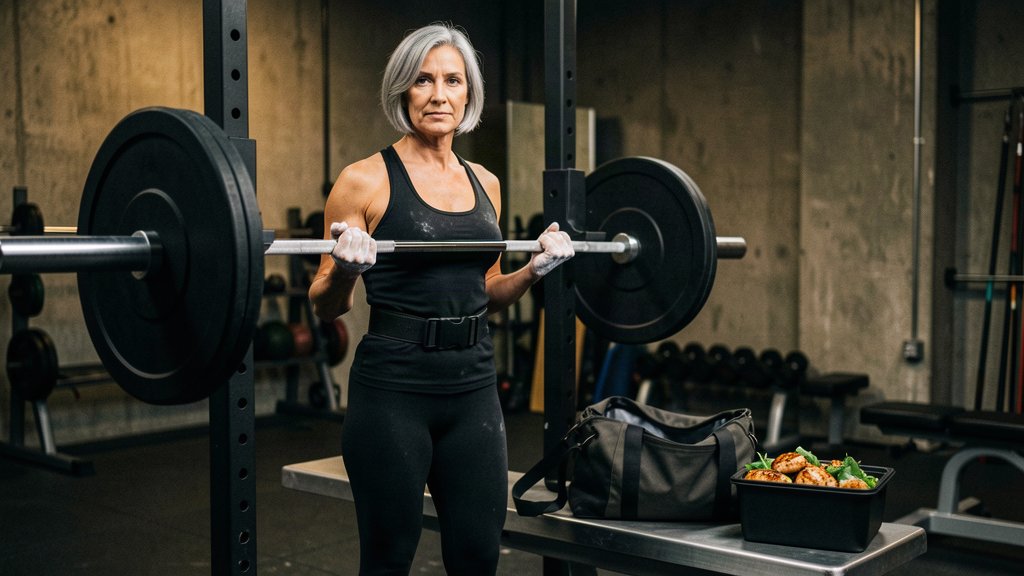
When a female lifter over 40 tells me she's "cleaning up her diet," she means eating less. Less bread. Less dinner. Less, period. Meanwhile her deadlift is stuck, her sleep is thin, and she's blaming her age for what is actually a fuel problem.
Here's the uncomfortable part: after 40, under-eating is the most common thing quietly capping a woman's strength. Not age. Not hormones. The nutrition picture for female powerlifters over 40 is simpler than the diet industry wants it to be. General food and training information, not medical advice.
Your Protein Number Is Higher Than Your Instincts Say
The cleanest protein evidence is a meta-analysis of 49 randomized trials and 1,863 people. Protein adds to the muscle and strength you build with resistance training up to about 1.6 g per kilogram of bodyweight per day. Above that, more buys nothing extra. Below it, you leave gains on the table [1].
The part for women at 40+: the effect of extra protein shrinks with age. The margin for error is thinner, and 1.6 g/kg is the floor, not a ceiling. At 65 kg, about 105 g a day; at 70 kg, about 112 g. Three or four meals of real food, not a supplement bill.
The second number is the per-meal threshold. Older adults need about 0.40 g per kg in a single meal to trigger muscle protein synthesis, versus about 0.24 g/kg in younger people [2]. The original study was in men, but the physiology, anabolic resistance, is not male. The takeaway: 25 to 30 g per meal, minimum, three to four times a day. Oatmeal with a splash of milk is not a protein meal. Two eggs with Greek yogurt is.
That's where leucine comes in: the amino acid that triggers the muscle-building response. You don't count grams. Build meals around complete proteins, meat, fish, eggs, dairy, soy, a palm-sized portion at every meal.
The Bone Math: Food Supports, Training Builds
The menopause transition is a bone event as much as a muscle event. Falling estrogen accelerates bone remodeling, and the SWAN cohort shows the shift: around the final menstrual period, fat gain doubles and lean mass declines [3].
Two inputs matter, and they're not equal in size.
Food supplies the raw material. The U.S. reference intake for calcium for adult women runs 1,000 to 1,200 mg a day [4]: roughly three servings of dairy or equivalents, yogurt, cheese, canned fish with bones, fortified plant milks. Vitamin D lets the gut absorb it; the reference intake is 600 IU a day, 800 after 70 [5], and food alone rarely covers it: fatty fish, egg yolks, fortified milk, sun exposure.
Training is the bigger lever. In LIFTMOR, postmenopausal women with low bone mass did eight months of supervised, progressive, heavy lifting: five sets of five at over 85% of their one-rep max, twice a week. Lumbar spine density rose 2.9% while controls lost 1.2%, and hip density held [6]. The takeaway is not "go max out on Tuesday." Heavy, well-progressed loading is the stimulus; calcium and vitamin D keep the building materials on site. You don't eat your way to stronger bone; you load your way there and feed the loading. The safety picture is answered in is powerlifting after 40 safe.
Under-Eating Is Quietly Eating Your Strength
The IOC consensus on Relative Energy Deficiency in Sport, RED-S, was written around young athletes; the mechanism has no age limit. When energy intake minus training expenditure leaves too little to run the body, the body cuts services: metabolic rate, immune function, hormones, bone health, protein synthesis [7]. Protein synthesis. The thing you're in the gym trying to buy.
At 40+, the silent version is everywhere: months of deficit, hard training, and recovery that keeps getting worse. It's not age. It's energy availability, and the fix is usually more food. Masters athletes eat more than the general population, because training raises protein and calcium needs [8]. You're an athlete; that's the job.
Signals that food is the problem: strength stalling for weeks, sleep quality dropping, mood flat, getting sick more often, joints aching without a cause. One is a training variable; two or three together, I'd look at the food log before touching the program.
The Scale Is the Wrong Instrument
Here's the trap the menopause transition sets. SWAN data show fat gain doubles at the transition's start while lean mass declines, and weight barely changes, because the two balance out on the scale [3]. A woman can weigh the same at 50 as at 42 and be a different body.
Crash dieting while strength training is the worst response. In Layman's trial, women in their mid-forties lost weight on higher- or lower-protein diets. Protein and exercise were additive: more fat lost, lean mass preserved [9]. A deficit is a tool for a defined period, not a lifestyle; it only works when protein stays at 1.6 g/kg and training stays heavy.
The scale measures mass. It can't see composition. Strength numbers, how clothes fit, waist circumference, and bar speed tell you more. If the weight is dropping and the squat is dropping with it, you're losing the wrong weight.
| Myth | Reality |
|---|---|
| "Eating less is how women get leaner." | After 40, under-eating erodes the muscle and bone you're training to build. Protein synthesis is one of the first systems cut when energy runs short [7]. |
| "Protein is for young men bulking." | The per-meal protein dose an older lifter needs to trigger muscle building is higher than a younger person's, not lower [2]. |
| "Calcium and vitamin D are the bone fix." | They're the building materials. Heavy, progressive loading is what builds bone [6]. |
What Actually Works: Creatine, and Nothing Else in a Tub
One supplement has real evidence in this population. A meta-analysis of 357 older adults found creatine added to resistance training increases fat-free mass and strength beyond training alone, with no change in fat mass [10]. The trials ran with adults averaging their mid-sixties; the effects are modest and consistent; creatine monohydrate is the most studied supplement on the market. It's not magic; it's a small honest edge, and whether to take it is a fair question for you and your clinician. The rest of the supplement aisle is optional.
A Food-First Week: A Pattern, Not a Meal Plan
Templates beat prescriptions:
| Meal | What it looks like | Protein anchor |
|---|---|---|
| Breakfast | 2-3 eggs plus Greek yogurt, cottage cheese, or cheese | 25-35 g |
| Lunch | Protein first, a fist of vegetables, a cupped hand of carbs: rice, potato, pasta, bread | 30-40 g |
| Post-training | Protein and carbs within a couple of hours: a shake, chicken and rice, yogurt and fruit | 25-35 g |
| Dinner | Same shape as lunch, protein first, vegetables, carbs scaled to training volume | 30-40 g |
| Snack, if needed | Nuts, cheese, eggs, edamame, leftovers | 10-20 g |
Three rules underneath. Protein at every meal, three meals minimum. Eat around training, not away from it. If you're in a deficit, protein stays at 1.6 g/kg and the deficit is modest, not a starvation month. Eating is a trainable skill, covered in nutrition is a skill.
The rule you can act on tonight: put 25 to 30 g of protein on every plate tomorrow, three meals minimum, and log your food like you log your lifts for one week. The numbers will show you where you actually are.
Hormones change the recovery math as much as the food math. Training through menopause as a powerlifter covers the readiness side of the same transition.
Frequently Asked Questions About Nutrition for Female Powerlifters Over 40
How much protein does a female powerlifter over 40 need?
About 1.6 g per kilogram of bodyweight per day, roughly 100 to 115 g for a 65 to 70 kg woman, across three to four meals of 25 to 40 g each [1][2]. After 40, be at it, not under it.
Do I need protein powder?
No. Powder is convenience, not necessity. Food comes first: meat, fish, eggs, dairy, soy. A shake is fine post-training when real food isn't practical.
Is heavy lifting safe for my bones if I have low bone density?
A clinician conversation, though the evidence is better than the old advice: in LIFTMOR, women with low bone mass improved spine and hip density on a supervised, progressive heavy program, with one minor adverse event across the trial [6].
Should I take calcium and vitamin D supplements?
Work the food first: three servings of dairy or fortified equivalents daily, plus fatty fish and eggs. Still short? Supplements are a clinician conversation, not a default [4][5].
Why is my strength stalling even though I never miss a session?
Check energy availability before you blame the program: a long deficit suppresses protein synthesis, recovery, and hormones [7]. If sleep is thin, progress is flat, and you've been dieting for months, food is the first variable to fix.
Will creatine make me gain weight?
It can add a little mass in the first weeks, mostly water inside muscle tissue, and the long-run change is fat-free mass, not fat [10]. Modest, real, and in the direction you want.
Fuel the Training, Then Stop Guessing the Load
The honest summary: nutrition for female powerlifters over 40 is not a secret diet. It's a protein target you actually hit, bone food on top of heavy loading, enough energy to pay for the training, and a scale you don't trust.
Which leaves the training itself. Food supplies the fuel. The program spends it, and a program that guesses your intensity spends it badly. That's what the CMS Adaptive System is for: the readiness engine reads your check-in, sleep, stress, fatigue, soreness, drive, and adjusts the day's load by roughly ±5%, so a bad day costs a few percent instead of a two-week setback. See how adaptive programming works, or start with the complete guide to training after 40.
Stop guessing your intensity. If a program expects you to guess, it's expecting too much of you. Start your 14-day free trial at app.cmstrength.fit/signup and let the programming spend the fuel you're finally putting in.
References
1. Morton RW, Murphy KT, McKellar SR, et al. A systematic review, meta-analysis and meta-regression of the effect of protein supplementation on resistance training-induced gains in muscle mass and strength in healthy adults. British Journal of Sports Medicine. 2018;52(6):376–384. https://doi.org/10.1136/bjsports-2017-097608
2. Moore DR, Churchward-Venne TA, Witard O, et al. Protein ingestion to stimulate myofibrillar protein synthesis requires greater relative protein intakes in healthy older versus younger men. Journals of Gerontology, Series A. 2015;70(1):57–62. https://doi.org/10.1093/gerona/glu103
3. Greendale GA, Sternfeld B, Huang MH, et al. Changes in body composition and weight during the menopause transition. JCI Insight. 2019;4(5):e124865. https://doi.org/10.1172/jci.insight.124865
4. National Institutes of Health, Office of Dietary Supplements. Calcium: Fact Sheet for Health Professionals. https://ods.od.nih.gov/factsheets/Calcium-HealthProfessional/
5. National Institutes of Health, Office of Dietary Supplements. Vitamin D: Fact Sheet for Health Professionals. https://ods.od.nih.gov/factsheets/VitaminD-HealthProfessional/
6. Watson SL, Weeks BK, Weis LJ, Harding AT, Horan SA, Beck BR. High-Intensity Resistance and Impact Training Improves Bone Mineral Density and Physical Function in Postmenopausal Women With Osteopenia and Osteoporosis: The LIFTMOR Randomized Controlled Trial. Journal of Bone and Mineral Research. 2018;33(2):211–220. https://doi.org/10.1002/jbmr.3284
7. Mountjoy M, Sundgot-Borgen JK, Burke LM, et al. IOC consensus statement on relative energy deficiency in sport (RED-S): 2018 update. British Journal of Sports Medicine. 2018;52(11):687–697. https://doi.org/10.1136/bjsports-2018-099193
8. Guo S, Shaoni GLL, Stuart-Smith WA, Davies AJ, Gifford JA. Dietary Intake of Masters Athletes: A Systematic Review. Nutrients. 2023;15(23):4973. https://doi.org/10.3390/nu15234973
9. Layman DK, Evans E, Baum JI, Seyler J, Erickson DJ, Boileau RA. Dietary protein and exercise have additive effects on body composition during weight loss in adult women. Journal of Nutrition. 2005;135(8):1903–1910. https://doi.org/10.1093/jn/135.8.1903
10. Devries MC, Phillips SM. Creatine supplementation during resistance training in older adults: a meta-analysis. Medicine & Science in Sports & Exercise. 2014;46(6):1194–1203. https://doi.org/10.1249/MSS.0000000000000220