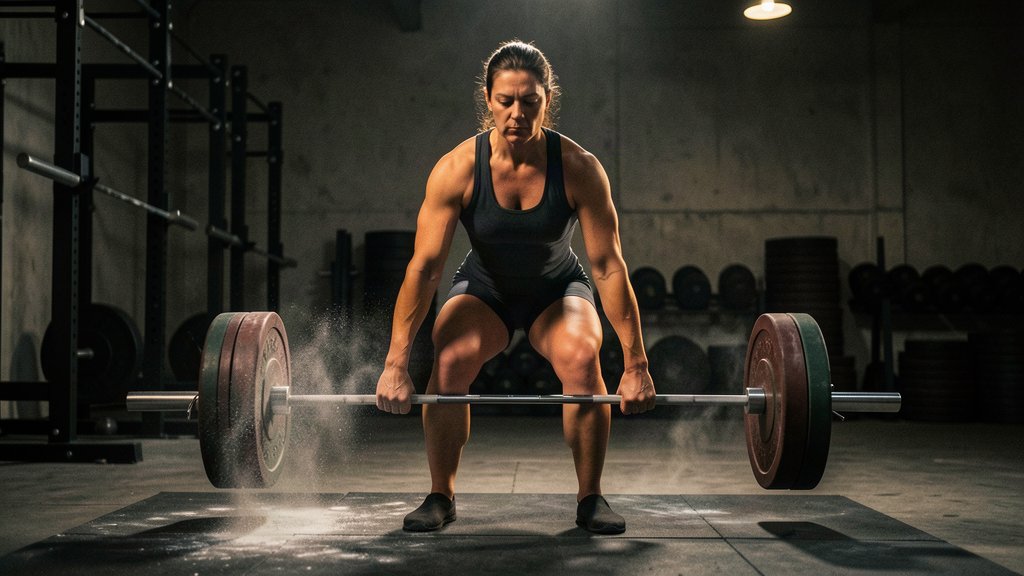
Let's name the question under the question. You're not really asking whether women can compete in powerlifting at 40. You're asking whether it's too late for you — whether a body that spent twenty years doing other things can walk onto a platform and hold its own.
That's the question that keeps women out of the sport. Not the weight. The doubt.
The answer has been in the record books for decades: it is not too late. The sport built entire divisions around your age. The research on women who compete into their sixties is in. And the women's side of the masters platform is one of the fastest-growing corners of strength sport on the planet.
Here's what the divisions look like, what the data shows, and how to get from "thinking about it" to "weighed in and warmed up."
The Sport Made a Division for Your Age
Powerlifting doesn't make masters athletes run a gentler race. It gives them a fair field: you're not competing against a 25-year-old for a masters medal, and the standards are identical — same commands, same depth, same judging.
The International Powerlifting Federation (IPF) runs its masters categories in decades:
| IPF Masters Category | Age Range |
|---|---|
| Masters I | 40–49 |
| Masters II | 50–59 |
| Masters III | 60–69 |
| Masters IV | 70+ |
USA Powerlifting (USAPL), the IPF's U.S. affiliate, splits domestic competition into five-year brackets — 40–44, 45–49, 50–54, up to 80+ — plus a submaster division (33–39) as the runway before masters proper.
Two details matter. Masters is an additional classification, not a separate sport — in most federations your total is also ranked in the Open at the same meet. And the scoring system assumes you keep improving — USAPL's masters age coefficients start at 1.000 at 40 and climb yearly. The formula treats 40 as the reference age, not the beginning of the end.
What the Record Books Actually Show
The honest version includes the part nobody wants to hear: age costs something. Recovery slows. Connective tissue doesn't signal until it's too late. You can't train like a 22-year-old.
Now the part the record books add: the cost is far smaller than you've been told.
A 2025 analysis in Kinesiology tracked 61 competitive powerlifters (16 women) with drug-tested results both before age 40 and after age 60 — 3,379 competition entries in all. Among the women, bench press performance actually increased by 0.27% per year into their sixties. Squat declined 0.11% per year. Relative strength declined 0.06% per year. Age explained just 0.4% to 15.6% of the variance — meaning 85% to 99% of why these women were strong had nothing to do with their age. The authors' conclusion is the headline: chronological age alone is a poor predictor of strength decline among well-trained older adults. And men declined steeper — the female masters curve is the flatter one.
That's the decades-long view. The late-start view is just as good. A 2024 analysis in Sports Medicine modeled 46,066 competition entries from 9,259 drug-tested IPF lifters: strength gains averaged 7.5–12.5% in year one and up to ~20% over ten years, with women gaining strength faster than men. Translation: your biggest strength gains may still be ahead of you.
Your competition isn't your 25-year-old self. It's your bracket — and most of them started exactly where you are.
Why Women Over 40 Are Flooding the Platform
The clearest window into this wave is the sister sport. At the U.S. Masters Weightlifting Championships, field size grew from 244 competitors in 2015 to 718 in 2019, and women's share of the field climbed from 14% to 59% between 2009 and 2019. That's Olympic weightlifting, but it's the same tide hitting the powerlifting platform. The reasons are plain:
- The goal is concrete. A meet is a date, a weigh-in, nine attempts, a total. Midlife is full of vague goals; powerlifting hands you a number.
- The progress is measurable. The bar either went up or it didn't.
- The field is real. Masters divisions mean you're not the token older woman in a room of 22-year-olds.
- The message finally fits. Women over 40 have been sold "cardio and core" for two decades. The masters platform is the counterargument, and it's winning.
Heavy Training Isn't the Risk. It's the Treatment.
The single most useful study for a 40+ woman considering powerlifting is LIFTMOR, a 2018 randomized trial in the Journal of Bone Mineral Research. Postmenopausal women with low bone mass — exactly the group conventional advice tells to be careful — trained twice a week for 30 minutes: five sets of five on the squat, deadlift, and overhead press at more than 85% of their one-rep max. Eight months later, the lifting group had gained 2.9% bone density at the lumbar spine while the low-intensity control group lost 1.2%. Femoral neck: +0.3% versus −1.9%. The group told to be careful got weaker bones. The group told to lift heavy built them.
Bone is the benefit everyone worries about, but it's not the only one. Women carry a higher risk of sarcopenia — age-related muscle loss — than men, and a 2025 meta-analysis in Frontiers in Public Health found resistance training improves strength and physical function in older women even once sarcopenia is present. The National Strength and Conditioning Association's position statement is equally direct: progressive resistance training is a first-line, safe strategy for preserving function in older adults.
Then there's the part research can't easily quantify: confidence. LIFTMOR's follow-up interviews found participants reporting a sense of achievement and feeling stronger; masters athletes cite the social side of training and strength they can apply to daily life. That's not wellness-fluff. That's what happens when you get strong on purpose, in public, in a sport that keeps score.
The myth table, since you'll hear these in every gym in America:
| Myth | Reality |
|---|---|
| "Powerlifting at 40 will wreck your joints." | Programmed loading with built-in recovery builds joint capacity. The unprogrammed grind is what hurts people — a program problem, not an age problem. |
| "Women over 40 should stick to light weights." | Bone and muscle respond to progressive strain. Light weights maintain; heavy weights (per the LIFTMOR protocol) build. |
| "You can't build muscle after menopause." | The research says otherwise — trained women in their sixties are still adding pounds to the bench press. |
The On-Ramp: Three Steps to Your First Meet
1. Find a local meet. USAPL maintains a sanctioned meet calendar covering every region of the country; IPF national federations do the same worldwide. Pick one three to four months out and register as a masters lifter — that's the whole first step, and it costs less than a pair of shoes.
2. Learn the commands. A meet is a skills test as much as a strength test. Squat: two commands — "Squat" to begin, "Rack" to finish. Bench: three — "Start," "Press," "Rack." Deadlift: one — "Down." Three attempts per lift, nine total; your best of each sums to your total. Practice with commands out loud from week one, so meet day feels like rehearsal, not a test.
3. Train with a program. Don't wing a twelve-week run-up to a meet. You want block periodization that builds submaximally, autoregulates intensity by how you're actually recovering, and schedules the deload before your body demands it — not a spreadsheet that assumes 25-year-old recovery. That's exactly what the Center Mass Strength Adaptive System runs: a readiness engine that checks your sleep, stress, fatigue, soreness, and drive each session, adjusts your loads ±5% accordingly, autoregulates via RPE and bar speed, tracks joint load, and peels back for a scheduled deload on week four. More on the machinery in our guide to adaptive powerlifting programming, and on the recovery side in our masters readiness deep dive.
Coach's note: pick a meet, put the date on the calendar, and train backward from it. The deadline does the motivating.
Ready to start? The complete guide to powerlifting after 40 covers the first twelve weeks and a realistic timeline to the platform. If perimenopause or menopause is part of the picture, how to train through menopause as a powerlifter covers the adjustments that matter, and nutrition for female powerlifters over 40 covers the fueling side.
Frequently Asked Questions About Women's Masters Powerlifting
Do I need to be strong before my first meet?
No. First meets are full of lifters who've trained for a year or less. Pick conservative openers and let the platform teach you the rest. Three white lights feel the same at 100 pounds as they do at 300.
Can I compete in both the Open and Masters divisions?
In most federations, masters is an additional ranking, not a separate event — you're scored in both your age bracket and the Open at the same meet. Check your federation's rulebook for specifics.
I'm 45 and have never touched a barbell. Is that disqualifying?
It's the norm, not the exception. The growth in masters participation has come mostly from people with no prior experience — and the first-year strength gains (7.5–12.5%) are the biggest you'll ever see.
What about osteoporosis?
Get medical clearance and work with a coach who understands loading — but the LIFTMOR trial was run on postmenopausal women with low bone mass, with heavy squats and deadlifts at the center of the protocol. The treatment for fragile bone is progressive loading, not fear of it.
Will heavy lifting make me bulky?
You'll get stronger before you get bigger — muscle accrual is a slow, earned process, which is exactly the kind worth starting at 40. Nobody accidentally looks like a powerlifter after eight months of training.
How much time does this take?
Three to four sessions a week, roughly an hour each, is the standard path. The meet itself is one day. The most expensive part of powerlifting isn't time — it's the cost of doing nothing.
The Sport Will Take You as You Are. The Program Should Too.
The platform doesn't care how long you've been lifting. It cares whether the bar moves, whether you hit depth, whether you wait for the command. That's a fair standard — and it's why so many women over 40 are choosing it.
But the training has to be honest about the cost — recovery, fatigue, connective tissue that won't be ignored. That's the difference between a program and a punishment. The Center Mass Strength Adaptive System meets you where your recovery actually is: readiness check-in every session, ±5% load adjustments, RPE and bar-speed autoregulation, block periodization, and a deload on week four scheduled before your body has to ask for it.
References
1. Watson SL, Weeks BK, Weis LJ, Harding AT, Horan SA, Beck BR. High-Intensity Resistance and Impact Training Improves Bone Mineral Density and Physical Function in Postmenopausal Women With Osteopenia and Osteoporosis: The LIFTMOR Randomized Controlled Trial. Journal of Bone and Mineral Research. 2018;33(2):211–220. doi:10.1002/jbmr.3284. https://pubmed.ncbi.nlm.nih.gov/28975661/
2. Wilf O, Dunsky A. Age Is a Poor Predictor of Maximal Strength in Competitive Powerlifters. Kinesiology. 2025;57(2):212–219. doi:10.26582/k.57.2.7. https://ojs.srce.hr/kinesiology/article/view/38002/18770
3. Latella C, van den Hoek D, Wolf M, Androulakis-Korakakis P, Fisher JP, Steele J. Using Powerlifting Athletes to Determine Strength Adaptations Across Ages in Males and Females: A Longitudinal Growth Modelling Approach. Sports Medicine. 2024;54(3):753–774. doi:10.1007/s40279-023-01962-6. https://link.springer.com/article/10.1007/s40279-023-01962-6
4. Huebner M, Meltzer D, Ma W, Arrow H. The Masters athlete in Olympic weightlifting: Training, lifestyle, health challenges, and gender differences. PLoS ONE. 2020;15(12):e0243652. doi:10.1371/journal.pone.0243652. https://pmc.ncbi.nlm.nih.gov/articles/PMC7717526/
5. Zhou Y, et al. Effects of resistance training on muscle mass, strength, and physical function in older women with sarcopenia: a systematic review and meta-analysis. Frontiers in Public Health. 2025;13:1735899. doi:10.3389/fpubh.2025.1735899. https://pmc.ncbi.nlm.nih.gov/articles/PMC12883749/
6. Fragala MS, Cadore EL, Dorgo S, Izquierdo M, Kraemer WJ, Peterson MD, Ryan ED. Resistance Training for Older Adults: Position Statement From the National Strength and Conditioning Association. Journal of Strength and Conditioning Research. 2019;33(8):2019–2052. doi:10.1519/JSC.0000000000003230.
7. USA Powerlifting. Rulebook (current edition) and Masters Age Coefficients. https://www.usapowerlifting.com/rulebook and https://www.usapowerlifting.com/pro (accessed August 2026).
8. International Powerlifting Federation. Records and Technical Rules. https://www.powerlifting.sport/championships/records (accessed August 2026).