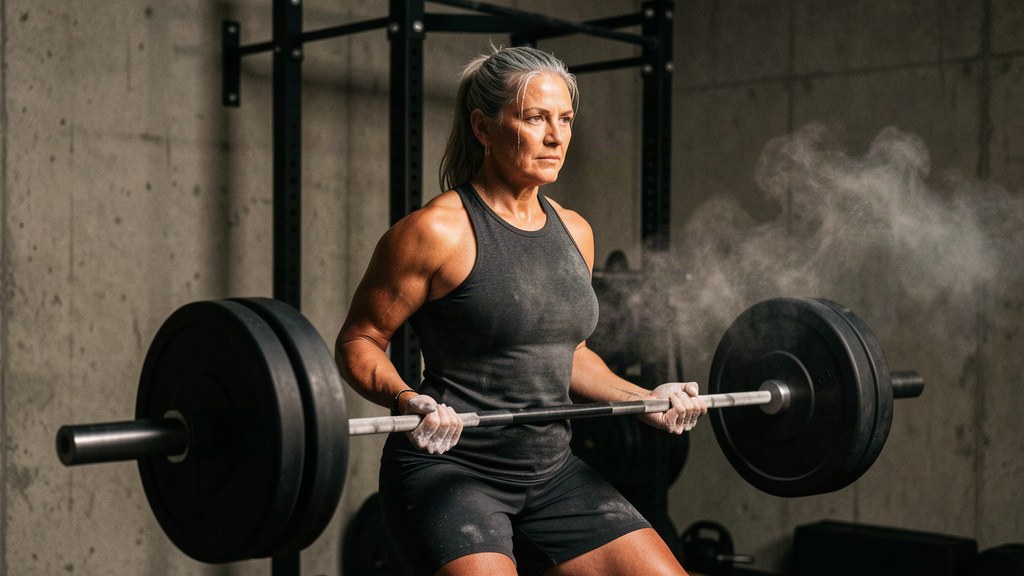
Let's name the moment nobody talks about. You're not worried about the barbell; it has been honest with you for years. You're worried about the body that meets it. The 3 a.m. wake-up that used to be a fluke and is now a pattern. The squat that moved light on Tuesday and sat heavy on Thursday for no reason you can name. The shoulder that started talking during a transition that has nothing to do with your shoulders. And underneath all of it, the question you won't say out loud: is this where the strength ends?
No. It isn't. But the training that got you here won't carry you through, and most of the advice aimed at you is either fear-mongering or pink-washed fluff. Here's the evidence-based version.
What Actually Changes Through the Transition
The menopausal transition is real, and it lands in the gym in specific ways. The honest list is shorter than the internet claims.
Body composition drifts. In a six-year longitudinal analysis of midlife women from the Study of Women's Health Across the Nation (SWAN), fat mass climbed by an average of 3.4 kg while skeletal muscle inched down, with waist circumference up about 5.7 cm [1]. Read those numbers carefully. The muscle loss is small and gradual in absolute terms; the fat gain is the bigger shift. Neither is destiny. Both respond to training.
Recovery stops being predictable. The single most reported symptom of the transition is broken sleep: roughly 40–60% of menopausal women report sleep problems, with hot flashes and night sweats affecting anywhere from a third to nearly nine in ten [2]. When your nights fragment, your training days vary, full stop. That variance is physiological, not a character flaw, and it's the main thing your programming has to absorb.
Joints get chatty. Muscle and joint pain is reported by roughly half to three-quarters of midlife women [2]. Some of that is connective tissue adapting on its own slow clock; some of it is just the normal noise of training. The problem is telling the two apart, which gets harder when symptoms vary week to week.
The thermostat resets. Vasomotor symptoms mean your internal temperature regulation is less forgiving. A hot flash mid-session isn't weakness; it's biology. Heat tolerance changes, and training plans that pretend otherwise will make you miserable for no gain.
None of this is a verdict on your strength career. It's a list of variables. And variables are what programming is for.
What the Research Actually Shows
Here is the headline, and it's a good one. A 2026 systematic review and meta-analysis pooled 126 resistance training studies covering 4,019 women, two-thirds of them postmenopausal. Strength gains were large in both groups, and the difference between premenopausal and postmenopausal women was statistically indistinguishable: standardized gains of 1.50 versus 1.46, no meaningful subgroup difference. Age, training frequency, and session duration showed no association with outcomes [3]. Translation: postmenopausal women respond to resistance training about as well as anyone. The machinery works.
The secondary results matter too. A meta-analysis of 12 randomized trials in postmenopausal women found resistance training improved menopausal symptoms and functional capacity, with the authors honest that the evidence is low-to-very-low certainty and better trials are needed [4]. That's the right amount of enthusiasm: promising, not oversold.
Bone gets its own evidence. A 2025 network meta-analysis of 55 randomized trials (3,454 postmenopausal women) found resistance training was one of the few exercise modalities that significantly increased bone mineral density at both the lumbar spine and the femoral neck relative to control [5]. The sister post on women competing at 40 digs into the LIFTMOR trial's numbers in depth; the point here is that heavy, progressive loading helps postmenopausal bone, and the meta-level evidence agrees.
Even protein behaves differently than the supplement aisle promises. In postmenopausal women, whey protein supplementation only enhanced strength and lean mass when combined with resistance training; without training, it did nothing [6]. The raw material is useless without the signal. Training is the signal.
| Myth | Reality |
|---|---|
| "Menopause ends your strength gains." | Postmenopausal women's strength gains were statistically indistinguishable from premenopausal women's across 126 studies [3]. |
| "Switch to light weights and yoga." | Resistance training improved symptoms and functional capacity [4], and it's one of the few modalities that significantly increased spine and femoral neck bone density [5]. |
| "Protein shakes are the fix." | Protein only paid off in combination with training; supplements without training did nothing [6]. |
| "Bad weeks mean the program is broken." | Symptom-driven variance is built into the transition [2]; the program needs to absorb it, not fight it. |
Why Readiness Becomes the Program
Here's the uncomfortable part, delivered straight: if your program is a fixed spreadsheet with fixed percentages, it is now guessing about your body roughly half the time. The transition made your daily capacity variable. A calendar can't see that. Only data can.
That's the whole case for readiness-based programming, and it stops being abstract during menopause. A thirty-second pre-workout check-in covering sleep, stress, fatigue, soreness, and drive tells you whether today's 80% is actually 80% or whether it's a disguised 90% with a two-week hangover attached. The readiness engine reads that check-in and adjusts the day's load by roughly ±5%: small enough to trust, large enough to keep a bad night from becoming a bad month. RPE and bar speed do the same job mid-set. A scheduled deload lands every fourth week before the body demands it. Joint load gets tracked across the block, so a chatty knee shifts the exercise before the knee makes the decision. That's the mechanism behind adaptive programming, and it matters more through this transition than anywhere else. The over-50 readiness deep-dive covers why readiness changes everything; the logic is identical, the stakes just arrive earlier.
The rule you can act on tonight: before you load the bar tomorrow, answer two questions, one line each: how did you sleep, and how do the joints feel? Those two answers set the weight.
The Adjustments That Matter
Load around the symptoms that actually show up. Heat is a training variable now: train in layers you can shed, keep a fan or a breeze, and don't chase intensity on hot-flash days. Joints get the same respect: when a joint is noisy, route around it with a variation that spares it instead of grinding through it. That's joint-load management, and it's how people still train in their sixties.
Treat protein as a floor, not a target to hit on good days. The intake range that shows up across this literature is roughly 1.2–1.5 g per kilogram of bodyweight per day [6]. Spread it across meals, and remember the punchline from the research: protein only builds when training is in place [6]. You're already doing the training half.
Sleep is the recovery engine's main input, and it's broken sometimes. Don't pretend otherwise. When sleep is off, the readiness check-in says so, and the load backs off accordingly. That's not weakness; that's accounting. Symptom management, including hormone therapy, is a conversation for your healthcare team, not for a training blog. This article is general training information, not medical advice. The training response is real regardless of what you and your doctor decide.
For the training plan underneath all of this, the complete guide to powerlifting after 40 lays out the programming principles and the first twelve weeks. The fueling side has its own playbook: protein, bone health, and fueling for female powerlifters over 40.
Frequently Asked Questions About Menopause and Powerlifting
Does menopause end strength gains?
No. Across 126 studies, postmenopausal women gained strength at rates statistically indistinguishable from premenopausal women, with no meaningful age effect [3]. Gains may be gated by recovery, not by capacity.
Is powerlifting safe during menopause?
For most women, yes, with the same sensible masters rules: a conservative training max, mostly submaximal work, deloads on schedule, and load adjusted to readiness. Heavy loading is one of the few things shown to help postmenopausal bone density [5]. Clear new pain or medical concerns with your healthcare team first.
Does resistance training help with menopause symptoms?
Some evidence says yes: a meta-analysis of 12 trials found resistance training improved menopausal symptoms and functional capacity, though the authors flag the evidence as low certainty [4]. The strength and muscle benefits are better established. Stay modest, keep training.
How should my training change during menopause?
The work stays, the guessing goes. Load against readiness instead of a fixed calendar, keep heavy days earned rather than assumed, schedule the deload, and raise the protein floor [6]. The transition changes the variables, not the verdict.
Do I need protein supplements?
No. Supplements only enhanced strength and lean mass in postmenopausal women when combined with resistance training; without training they did nothing [6]. Hit the daily intake from food first. Supplements are convenience, not medicine.
Outlast the Transition
Here's the honest bottom line: menopause doesn't end your strength career. It ends the illusion that training is a fixed equation. The women who lift through this transition, and past it, aren't doing less; they're doing the right amount on the right day, and they're letting the body's actual state set the schedule. The strength response is waiting on the other side, and the research says it's as real as it ever was [3].
The catch is that managing check-ins, RPE calls, deload timing, and joint-load accounting by hand is a full-time coaching job. That's what the Adaptive System is for: the readiness engine reads your check-in and adjusts the day's load, the deload is scheduled before your body demands it, and joint load is tracked across the block. You do the lifting. The system does the accounting.
Stop guessing your intensity. If a program expects you to guess, it's expecting too much of you. Start your 14-day free trial at app.cmstrength.fit/signup and let the programming carry the load you used to carry in your head.
References
1. Sowers M, Zheng H, Tomey K, et al. Changes in Body Composition in Women Over Six Years at Midlife: Ovarian and Chronological Aging. Journal of Clinical Endocrinology & Metabolism. 2007;92(3):895–901. https://doi.org/10.1210/jc.2006-1393
2. Baker FC, Lampio L, Saaresranta T, Polo-Kantola P. Sleep and Sleep Disorders in the Menopausal Transition. Sleep Medicine Clinics. 2018;13(3):443–456. https://doi.org/10.1016/j.jsmc.2018.04.011
3. Isenmann E, Geisler S, Havers T, Siegert F, Hemke F, Held S. It's Never Too Late: The Impact of Resistance Training on Strength and Body Composition in Females Across the Lifespan: A Systematic Review and Meta-Analysis. Journal of Science and Medicine in Sport. 2026. https://doi.org/10.1016/j.jsams.2026.03.002
4. Sá IA, et al. Resistance Training for Postmenopausal Women: Systematic Review and Meta-Analysis. Menopause. 2023;30(1):108–116. https://doi.org/10.1097/GME.0000000000002079
5. Ma M, Su W, Liu D. Effects of Different Exercise Interventions on Bone Mineral Density in Elderly Postmenopausal Women: A Network Meta-Analysis. Frontiers in Physiology. 2025;16:1633913. https://doi.org/10.3389/fphys.2025.1633913
6. Kuo YY, Chang HY, Huang YC, Liu CW. Effect of Whey Protein Supplementation in Postmenopausal Women: A Systematic Review and Meta-Analysis. Nutrients. 2022;14(19):4210. https://doi.org/10.3390/nu14194210