We covered the why of carbs in Carbs for Powerlifting: heavy sessions run on glycogen, and a bad training day is often a nutrition day in costume. This is the operations manual that sits underneath it — the actual clock, the actual grams, the actual food.
Peri-workout fueling has three windows: pre, during, and post. None of them require precision. All of them reward consistency.
Before: The 3–4 Hour Window and the 1–2 Hour Window
Your pre-training meal has one job: land you in the gym with full glycogen and an empty-ish stomach. Fat and fiber slow digestion, so the closer you eat to training, the smaller and simpler the meal should be.
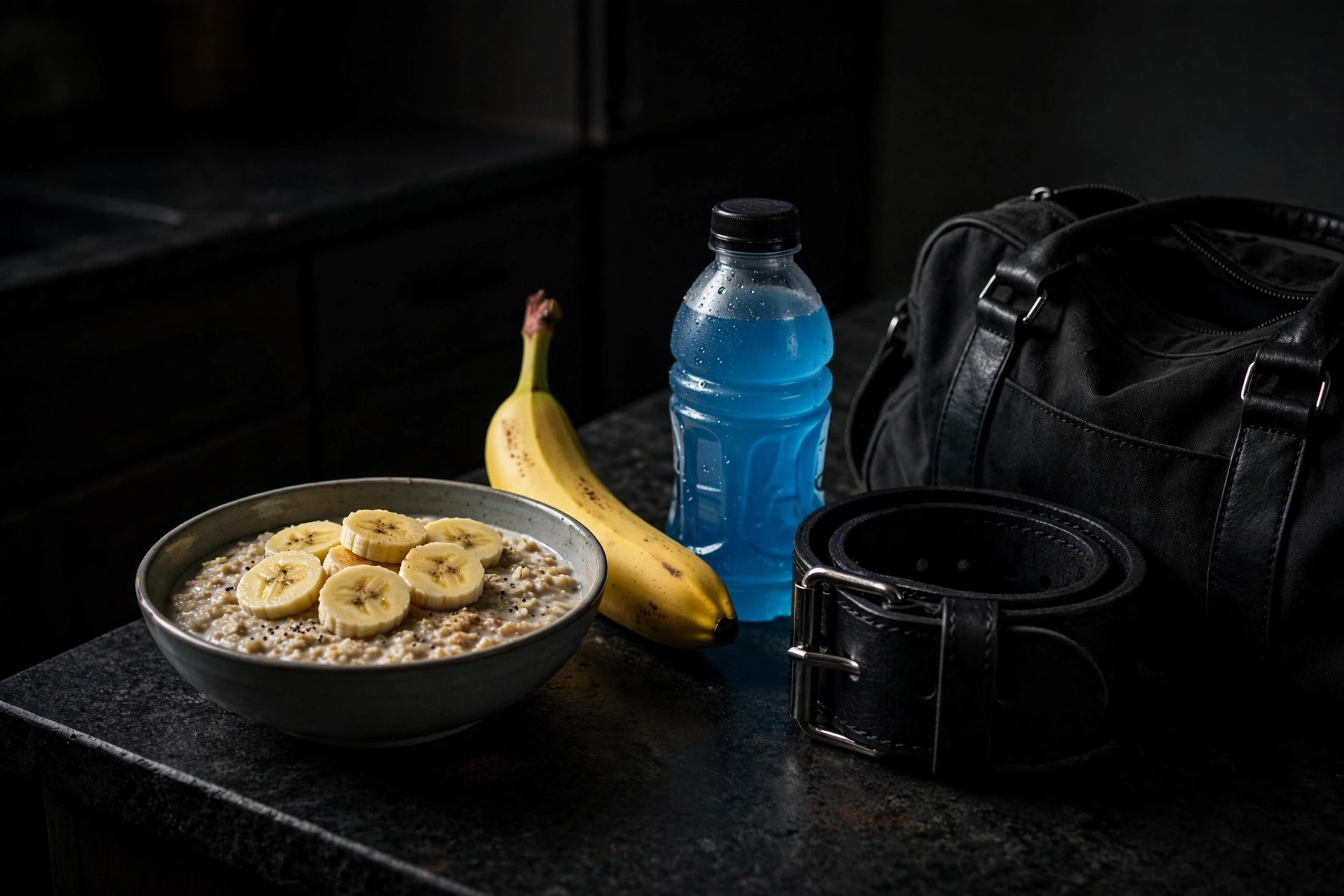
3 to 4 hours out: eat a real meal — roughly 1 to 2 g of carbs per kg of bodyweight, with some protein. For a 90-kg lifter that’s 90 to 180 g of carbs: rice with lean meat, pasta with chicken, oatmeal with fruit and yogurt. This is the meal that does the heavy lifting for the session.
1 to 2 hours out: if training sneaks up on you, a smaller snack — about 0.5 to 1 g/kg — low in fat and fiber. A bagel with jam, a banana and a sports drink, a bowl of cereal with skim milk. These are the numbers sports nutrition position stands converge on [1][2], and they hold up well in practice.
What to avoid in both windows: a giant fatty meal right before training (it sits in the stomach and makes heavy squats miserable), and experimenting with new foods on a heavy day. Train your food like you train your lifts — test it on ordinary days, deploy it on hard ones.
During: When Intra-Workout Carbs Earn Their Place
For a normal 45-to-60-minute session, you don’t need intra-workout fuel. Your pre-training meal covers you, and the research is consistent that short sessions don’t benefit from sipping carbs [1].
The long session is different. A two-hour heavy day — squat top sets, deadlift volume, accessories — burns through glycogen, and work output tends to fall off in the back half. For sessions over about 90 minutes, sipping roughly 30 to 60 g of fast carbs per hour can help hold up performance: a bottle of sports drink, a handful of gummy candy between sets, a banana at the midpoint [3].
Two practical notes. First, this pairs naturally with hydration — you’re drinking something anyway between heavy sets. Second, don’t confuse “intra-workout” with “license to eat a candy bar.” It’s a modest carb drip for a long session, not a pre-workout ritual for your bench day.
After: Recovery Starts at the Table
Post-training nutrition has two components: carbs to start refilling glycogen, and protein to give muscle the material to rebuild. Total daily intake matters more than the exact minute you eat — but a carb-plus-protein meal within a couple of hours after training is a solid, well-supported habit [1][4].
The guideline number: roughly 1 to 1.2 g of carbs per kg of bodyweight in the post-training meal, plus 20 to 40 g of protein [2]. For our 90-kg lifter, that’s about 90 to 110 g of carbs: a big plate of rice or pasta with meat, two burritos, a large sandwich meal with fruit and chocolate milk. Nothing exotic. Just food, soon after training, with carbs in it.
And no — the anabolic window isn’t a 30-minute countdown timer. The research review that popularized the panic also clarified it: if you ate a proper pre-training meal a few hours earlier, the post-workout urgency drops a lot [4]. The lifter who trains at 6 and eats a full dinner at 7:30 is covered. The lifter who trains fasted at 5 AM and skips breakfast until noon is the one leaving recovery on the table.
Tricky Schedules: 5 AM, Lunch Hour, Evenings
The framework adapts to the clock, and most lifters train at a bad hour. Here’s how each one works.
Early morning (5–6 AM): you’re not eating a full meal at 4:30. Keep it light and fast: a banana, a sports drink, or a small bowl of cereal 30 to 60 minutes before. The real fueling work happened at dinner the night before — a carb-rich evening meal is what tops up glycogen for morning training. Then eat a real breakfast with protein after the session.
Lunch hour: breakfast is your 3-to-4-hour meal. Make it carb-forward — oatmeal, toast, cereal — not just eggs and coffee. A small sports drink or piece of fruit an hour before training tops it off. Eat lunch after.
Evenings (after work): lunch is your 3-to-4-hour meal; an afternoon snack (fruit, granola bar) is your 1-to-2-hour window. Train, then eat dinner as your post-training meal. This is the easiest schedule to fuel — the day’s eating naturally brackets the session.
What Not to Do
- Train a heavy session truly fasted. Performance on fasted heavy squats is a lottery ticket. If mornings are your only window, at least drink something with carbs.
- Eat a giant fatty meal right before training. Fat slows gastric emptying; you’ll feel it on every set of squats.
- Skip the post-training meal entirely. Nothing breaks recovery consistency faster than training hard and then not eating until dinner.
- Turn intra-workout into a crutch. If you need candy to survive a 45-minute session, the problem is the pre-training meal, not the lack of intra carbs.
The Takeaway
Peri-workout fueling is simple: a carb-rich meal 3 to 4 hours out (or a small one 1 to 2 hours out), fast carbs during long sessions, and a carb-plus-protein meal within a couple of hours after. None of it requires a scale or a spreadsheet — just the habit of feeding the session instead of showing up on fumes. The lifts don’t care about your macros in the abstract. They care whether the tank was full when the work started.
References
[1] Kerksick, C. M., Arent, S., Schoenfeld, B. J., Stout, J. R., Campbell, B., Wilborn, C. D., Taylor, L., Kalman, D., Smith-Ryan, A. E., Kreider, R. B., Willoughby, D., Arciero, P. J., VanDusseldorp, T. A., Ormsbee, M. J., Wildman, R., Greenwood, M., Ziegenfuss, T. N., Aragon, A. A., & Antonio, J. (2017). International Society of Sports Nutrition Position Stand: Nutrient Timing Revisited. Journal of the International Society of Sports Nutrition, 14, 33. https://doi.org/10.1186/s12970-017-0189-4
[2] Thomas, D. T., Erdman, K. A., & Burke, L. M. (2016). Position of the Academy of Nutrition and Dietetics, Dietitians of Canada, and the American College of Sports Medicine: Nutrition and Athletic Performance. Journal of the Academy of Nutrition and Dietetics, 116(3), 501–528. https://doi.org/10.1016/j.jand.2015.12.006
[3] Burke, L. M., Hawley, J. A., Wong, S. H. S., & Jeukendrup, A. E. (2011). Carbohydrates for Training and Competition. Journal of Sports Sciences, 29(S1), S17–S27. https://doi.org/10.1080/02640414.2011.585473
[4] Aragon, A. A., & Schoenfeld, B. J. (2013). Nutrient Timing Revisited: Is There a Post-Exercise Anabolic Window? Journal of the International Society of Sports Nutrition, 10, 5. https://doi.org/10.1186/1550-2783-10-5