Ask a hundred gym-goers what "weightlifting" means and most of them will describe powerlifting. Ask a powerlifter and a weightlifter what they do and they'll give you two answers that share almost nothing except a barbell. The confusion is everywhere — even in the names. "Weightlifting" is the Olympic sport with the snatch and the clean and jerk. "Powerlifting" is the sport with the squat, the bench press, and the deadlift. They're different sports with different lifts, different training, different judging, different gear, and a different kind of athlete doing well at each. This is the full, honest comparison: what each sport is, how they train, what competition looks like, where they overlap, and how to pick the one that fits your body and your life — including the over-40 reality check, because that's who reads this site.
The short version
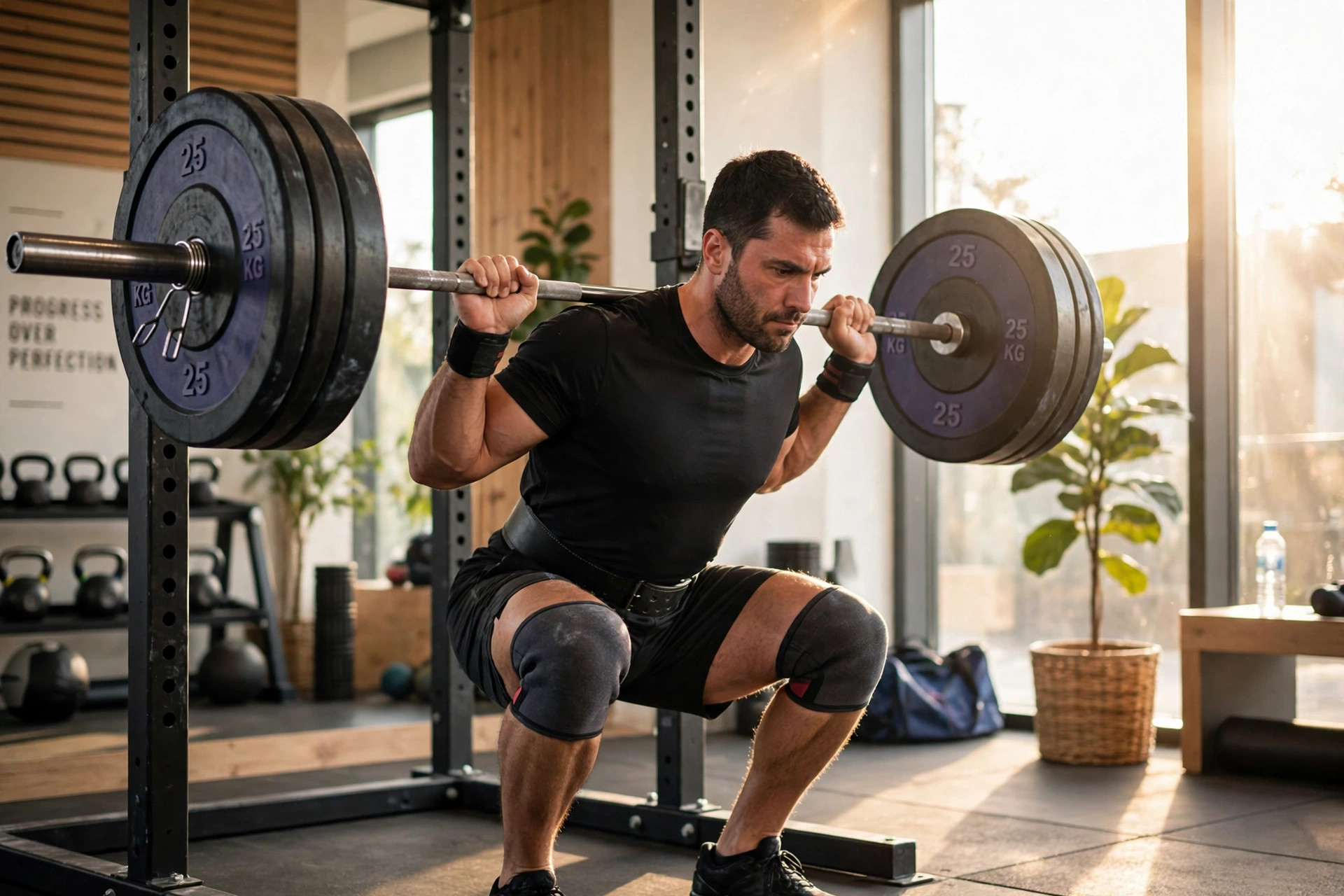
Powerlifting tests maximal strength in three lifts: the squat, the bench press, and the deadlift. Each lift is slow, grinding, and judged on a single maximum — how much weight you can move once, with legal form, in a singlet, usually with a belt, wrist wraps, and knee sleeves or wraps. Your total is the sum of your best squat, best bench, and best deadlift.
Weightlifting (capital W, the Olympic sport, also called Olympic weightlifting) tests explosive power in two lifts: the snatch and the clean and jerk. Both are fast, technical, full-body movements where the bar goes from the floor to overhead in one or two explosive motions. Your total is your best snatch plus your best clean and jerk.
One rewards patience and grind. The other rewards speed and precision. That difference shapes everything downstream: how you train, what coaching you need, what a meet feels like, and which one keeps you in the game longer.
The lifts, side by side
Powerlifting's three: squat (bar on your back, down to depth, stand up), bench press (bar to the chest with a pause, press to lockout), deadlift (bar off the floor to standing, no bounce, no hitch). Every rep is a controlled grind — the bar moves slowly, the effort is maximal, and the whole skill is producing force against something that barely wants to move. A missed lift in powerlifting is almost always a strength failure: you just couldn't finish the rep.
Weightlifting's two: the snatch (bar from the floor to overhead in one continuous motion, caught in a deep squat) and the clean and jerk (bar to the shoulders in one motion — the clean — then driven overhead in a second — the jerk). Both are over in about two seconds. The bar moves fast, the positions are exact, and a missed lift is almost always a technical failure: the pull was an inch off, the catch was soft, the timing broke down. Weightlifters miss weights they can easily "muscle" in other movements because the lift punishes imprecision.
The overlap is exactly one thing: both sports require you to be strong under a barbell. But powerlifting strength is slow maximal force — can you produce it for five grinding seconds? Weightlifting strength is explosive — can you produce it in a fraction of a second, in exactly the right positions? Those are different athletic qualities, and training for one does not automatically build the other. A 500-pound deadlifter can still be terrible at the snatch, and a sharp snatcher can have a mediocre bench. The powerlifting exercises guide breaks down how the three powerlifts get trained; notice how little of it involves moving a bar fast.
How the training differs
Powerlifting training is submaximal volume at honest percentages. Most of the work lives in the 70–85% range — sets of 3–8 on the competition lifts, variations that attack sticking points (pause squats, board presses, deficit deadlifts), and accessories that build the muscles the big lifts need. A powerlifter trains four or five days a week, sessions run 60–120 minutes, and the week is built around progression models: add weight, add reps, add sets, repeat. The skill curve is gentle. You can self-coach a powerlifting program from a good template for years — the lifts are simple enough that video review and honest percentages get you most of the way. That's exactly what the powerlifting program guide is built for.
Weightlifting training is technical practice at moderate weights, constantly. Weightlifters train the snatch and clean and jerk — or pieces of them — nearly every session, often 5–6 days a week, because the lifts are skills that degrade fast. Sessions are full of singles and doubles at 60–80%, drilling positions: pulls, hangs, blocks, complexes. The programming looks boring to an outsider (the same two lifts, forever) and the progress is maddeningly non-linear: you can add 5 kilos to your clean and jerk in a week when a technical fix lands, then stall for six months on the snatch because your turnover is lazy.
The coaching gap is the biggest practical difference. A beginner powerlifter can start from a template and film. A beginner weightlifter really should have a coach — not forever, but at the start, because the snatch and clean are genuinely hard to learn from video alone. Bad positions drilled ten thousand times become a permanent ceiling. Most cities have a weightlifting club with a coach who'll teach you the lifts for a reasonable monthly fee; that coaching is the single highest-ROI purchase in weightlifting, full stop.
What competition looks like in each
A powerlifting meet is a long day. You weigh in, then lift in three sessions — squat first, bench second, deadlift last — with three attempts at each lift. Between attempts you're warming up, resting 10–20 minutes, and trying to stay warm without burning out. The day runs 8–10 hours. You pick your own attempts, and attempt selection is half the game: open too heavy and you bomb out (three misses on any lift means no total), open too light and you leave kilos on the platform. The atmosphere is grinding and loud — heavy singles, big crowds around the platform, chalk everywhere. The meet prep guide walks through the whole day.
A weightlifting meet is shorter and weirder to watch. You get three attempts at the snatch, then three at the clean and jerk, and the whole session for your group takes about two hours. The bar changes are constant — the loaders are sprinting. Attempts climb in small jumps, and strategy matters differently: in weightlifting, you follow yourself (take your next attempt soon after your last), which means conditioning between attempts is a real factor. Misses are dramatic — a dropped barbell from overhead is normal and expected, not a catastrophe. And the judging is stricter on movement quality: press-outs, uneven lockouts, and elbow touches get red lights. Powerlifting judging cares about depth, pauses, and commands; weightlifting judging cares about whether the lift looked like the lift.
Both sports use weight classes (the powerlifting weight classes guide covers the powerlifting side), both have masters divisions that start at 35, and both have drug-tested and untested federations — the alphabet soup is real in both sports. Entry fees are similar, singlets are required in both, and the community in both is genuinely welcoming to new lifters. Nobody cares what you total at your first meet in either sport. They care that you showed up.
The gear and the gym question
Powerlifting gear: a belt, wrist wraps, knee sleeves (or wraps, depending on the federation), flat shoes or heeled squat shoes, chalk. Total startup cost for decent gear: $200–400, and it lasts years. You can powerlift in any gym with a squat rack, a bench, a barbell, and plates — which is nearly every gym on earth. Home gym powerlifting is the norm, not the exception.
Weightlifting gear: heeled weightlifting shoes (non-negotiable — the elevated heel is part of the positions), a belt, wrist wraps, chalk, and crucially, a platform with bumper plates you can drop. You cannot learn the snatch in a commercial gym that bans dropping weights. Weightlifting needs a weightlifting-friendly gym: a club, a CrossFit box with open gym hours, or a home setup with a platform and bumpers. That gym requirement is the single biggest logistical barrier in the sport — more than the coaching, more than the technique.
If you train at a standard commercial gym, powerlifting fits your life with zero friction. If you want to do weightlifting, check the dropping policy before anything else.
Which one builds what
For raw strength: powerlifting wins, obviously — the entire sport is a measurement of it. Powerlifters are the strongest humans on slow, heavy compound movements.
For athleticism: weightlifting wins. The snatch and clean and jerk build explosive power, coordination, mobility, and body awareness that transfer to basically every other sport. Football programs, track programs, and combat sports have used the Olympic lifts for decades for exactly this reason.
For muscle: it's closer than people think, and it depends on the programming. Powerlifting's accessory work builds plenty of mass; weightlifting's constant pulling builds a thick back and traps. Neither sport is bodybuilding — if the goal is purely size, the bodybuilding vs powerlifting breakdown is the honest comparison to read.
For mobility: weightlifting demands it and builds it. You cannot catch a snatch in a deep overhead squat without serious ankle, hip, thoracic, and shoulder mobility — the sport forces you to earn it. Powerlifting requires much less: enough hip mobility to hit squat depth, enough shoulder mobility to hold a low bar. If you're stiff, powerlifting meets you where you are; weightlifting makes you fix it.
The over-40 verdict: which one fits your life
Here's the part that matters for this audience. Both sports have thriving masters divisions — the 40+ and 50+ categories at national meets are deep and competitive, and some of the most consistent lifters in either sport started after 40. But the two sports ask different things of an older body.
Powerlifting is the lower-friction choice after 40. The lifts are simple to learn, you can self-coach from a template, any gym works, the training is submaximal and joint-friendly when programmed honestly, and the skill curve doesn't punish you for starting late. The injury risks are real but manageable: they're the chronic, predictable ones — shoulders from too much bench volume, backs from deadlift ego — and the form guide for older lifters exists precisely because those risks are well understood. A 45-year-old can start powerlifting on Monday with a barbell and a spreadsheet and be competing within a year.
Weightlifting after 40 is absolutely doable — with caveats. The mobility demands are the real gate: if your ankles, hips, and shoulders are stiff from twenty years at a desk, the snatch will make you fix that before it lets you progress, and that process takes months. You need a coach, at least at first, and you need a gym where dropping is allowed. The explosive nature of the lifts is actually joint-friendly in one sense — you're never grinding a maximal rep for ten seconds — but the positions punish sloppiness fast, and a bad catch at 40 costs more than a bad catch at 22. The lifters who thrive in masters weightlifting are the ones who embrace the technique-first mindset: light weights, perfect positions, patience measured in years.
The honest answer: if you want to get as strong as possible with the least logistical friction, pick powerlifting. If you're drawn to the athleticism, the speed, the technical craft — and you're willing to get coaching and fix your mobility — pick weightlifting. And if you're genuinely torn, do what plenty of lifters do: powerlift as the base, and learn the power clean as an accessory. You get most of the explosiveness with none of the meet logistics.
Can you do both?
Yes, with priorities. Plenty of lifters train the powerlifts for strength and the Olympic lifts for power in the same week — it's a classic combination, and the squat strength from powerlifting carries directly into the clean. The conflict is time and recovery: weightlifting wants frequent technical practice, powerlifting wants heavy submaximal volume, and doing both at full intensity is a recovery bill most people can't pay. The practical version: run a powerlifting program as the base, and do the Olympic lifts (or just the power clean and push press) as light technical work twice a week. Compete in whichever one you actually want to compete in. Trying to peak for both at once is how you get mediocre at both.
How to start, whichever you pick
Starting powerlifting: learn the three lifts from a good guide, pick a beginner program built on submaximal percentages, film your sets, and run it for 12 weeks before you change anything. Enter a local meet when you can squat, bench, and deadlift with legal form — the total doesn't matter. The powerlifting program guide is the starting template.
Starting weightlifting: find a club or a coach first — before you buy shoes, before you program anything. Spend the first 2–3 months on technique with a PVC pipe and an empty bar; this is not wasted time, it's the entire foundation. Get the shoes when the positions start to click. Enter a local meet when you can snatch and clean and jerk legally at any weight — again, the total doesn't matter.
Whichever you choose, the rule is the same one that governs all of this: pick the sport you'll still be doing in five years. The best program is the one you run. The best sport is the one you don't quit.